
If your husband won’t make decisions, it can eventually feel like much more than indecisiveness. You may find yourself choosing where the family goes, what gets purchased, how problems are handled, which contractor to hire, what happens with the children, where you vacation, or even what the two of you eat for dinner. After enough repetitions of “Whatever you want” or “I don’t care,” the practical burden begins to feel emotional as well.
The frustration is understandable, but the first question is not whether your husband is simply bad at making decisions. It is whether he cannot decide, is afraid to decide, has learned not to decide, does not consider the decision important, or is deliberately avoiding the responsibility that comes with choosing. Those possibilities can look remarkably similar from the outside while requiring very different responses.
Difficulty making decisions is not inherently a male trait. Research points instead to factors such as confidence, information, personality, stress, fear of error, expectations around competence, avoidance, and the number or complexity of choices involved. Some men may also feel pressure to appear certain and self-reliant, making it harder to admit that they are confused or need help.
The goal of this article is therefore not to excuse a husband who leaves every difficult choice to his wife. It is to help you identify the pattern more accurately. When you understand what happens immediately before he avoids a decision, what kinds of decisions trigger the problem, and what he does when you ask him to take responsibility, you can respond to the actual issue rather than arguing about the symptom.
- A husband who will not make decisions is not necessarily refusing. Fear of making the wrong choice, low confidence, conflict avoidance, stress, too many options, and established relationship roles can all contribute.
- The most useful distinction is whether he is temporarily uncertain, chronically avoidant, or deliberately shifting responsibility onto you.
- Indecision becomes a relationship problem when one partner repeatedly carries the mental load, responsibility, and consequences of choices that should be shared.
- Helping does not mean making every choice for him. Clear ownership, limited options, reasonable deadlines, and agreed decision criteria can make decision-making easier without reinforcing passivity.
- New or severe indecision accompanied by persistent sadness, anxiety, exhaustion, loss of motivation, or impaired functioning deserves appropriate professional attention.
- Is He Refusing to Decide or Struggling to Decide?
- 1. He Is Afraid of Making the Wrong Choice
- 2. He Does Not Want to Be Blamed for the Outcome
- 3. He Does Not Feel Confident Enough to Choose
- 4. Indecision Helps Him Avoid Conflict
- 5. There Are Too Many Options
- 6. Stress, Burnout, or Low Mood May Be Making Decisions Harder
- 7. You May Have Different Decision-Making Styles
- 8. The Relationship May Have Trained Both of You Into This Pattern
- 9. He May Not Consider the Decision Important
- When Indecision Really Is a Refusal to Take Responsibility
- What to Do When Your Husband Won’t Make Decisions
- What Usually Makes the Pattern Worse
- When Professional Help Makes Sense
- Frequently Asked Questions
Is He Refusing to Decide or Struggling to Decide?
When a husband won’t make decisions, the most important distinction is whether he is unwilling to take responsibility or genuinely struggling with the process of choosing. The outward behavior can look identical either way. In both cases, he may say “Whatever you want,” delay giving an answer, ask you to choose, or avoid the conversation until circumstances make the decision for both of you.
The pattern becomes clearer when you look at context. Is he decisive at work but passive at home? Does he struggle only when money is involved? Does he become stuck when there are many possible choices? Does he ask for more information repeatedly? Does he seem worried about disappointing you? Does he avoid decisions only when the consequences could be blamed on him?
Those details are often more informative than the simple fact that he is a man who appears indecisive.
Research on decision-making supports this more nuanced approach. Studies describe different personality traits and decision-making styles, including tendencies toward avoidance, flexibility, deliberation, and structured analysis. People do not all approach uncertainty in the same way, and slower decision-making is not automatically evidence of irresponsibility.
The relationship problem begins when the pattern becomes chronically one-sided. If you continually research the options, initiate the conversation, make the final choice, and absorb the consequences, you are not simply living with someone who thinks differently. You may be carrying an unfair portion of the relationship’s decision-making load. It is the same kind of imbalance explored in our guide to how low self-esteem in relationships can quietly shift responsibility onto one partner — a pattern that often plays out around decisions as much as anything else.
1. He Is Afraid of Making the Wrong Choice
Fear of making the wrong decision is one of the simplest explanations for chronic indecision. The higher the perceived stakes, the stronger that fear can become. Choosing a restaurant rarely matters much. Choosing whether to move, change jobs, refinance a house, have another child, or make a major purchase carries consequences that cannot always be reversed easily.
The difficulty is that uncertainty cannot be eliminated from most meaningful decisions. A person who believes he needs to know the correct answer before choosing can therefore remain stuck indefinitely. More research produces more possibilities, and more possibilities create more questions.
This pattern often looks responsible at first. Your husband may say that he wants to “think it through” or “make sure we get it right.” That can be reasonable. The question is whether additional thought eventually leads to a decision or simply postpones the discomfort of choosing.
Research into difficulties involved in decision-making has identified issues such as limited information, lack of clarity, and uncertainty as barriers to choosing. The study focused on career decisions rather than marital decision-making, so it should not be generalized directly to husbands. The underlying point is still useful: people often struggle more when they do not feel they understand the options or themselves well enough.
When this is the pattern, the solution is rarely “think about it until you become completely certain.” A better goal is enough information to make a reasonable decision while accepting that some uncertainty remains.
2. He Does Not Want to Be Blamed for the Outcome
Sometimes the problem is less fear of the decision itself and more fear of owning the result. If a choice goes badly, the person who made it can feel responsible. Avoiding the choice becomes a way of avoiding that exposure.
This can create a particularly frustrating marital pattern. You ask what he wants to do, and he insists that you choose. If your choice works well, everything is fine. If it goes badly, however, you may still find yourself hearing criticism about what “we should have done.”
That dynamic deserves attention because it is no longer neutral indecision. It transfers both authority and risk to one partner. You become responsible for making the decision while he preserves the ability to evaluate it afterward.
A healthier marriage requires shared tolerance for imperfect outcomes. If both people participated honestly and made the best decision they reasonably could with the information available, a disappointing result does not automatically mean someone failed.
This is particularly important with financial, parenting, and career choices. Couples who expect every major decision to produce the best possible outcome create an environment in which admitting uncertainty becomes dangerous. When mistakes become information rather than ammunition, both partners have more room to participate.
3. He Does Not Feel Confident Enough to Choose
A husband may also avoid decisions because he does not trust his own judgment. This does not necessarily mean low self-esteem in a broad psychological sense. He may simply feel underqualified in a particular area or believe that you understand the subject better than he does. For a broader look at how a negative self-view can show up across a man’s life, see the signs of low self-esteem in men.
If you manage the family finances, for example, he may defer to you because you know more about the accounts. If he handles automotive decisions, you may do the same in return. A division of expertise can be efficient.
The problem begins when “You know more about this” expands into “You decide everything.” Over time, the less one partner participates, the less confident that person may become. The more confident partner then takes over even more decisions because doing so is quicker.
The result is a self-reinforcing system. One spouse becomes the permanent decision-maker while the other becomes increasingly passive.
Research into decision difficulty has identified lack of information and uncertainty as meaningful barriers, but confidence also grows through practice. If every uncertain decision is immediately handed to the more decisive spouse, there is little opportunity for the less confident partner to develop his own judgment.
When this is the issue, the answer is not to abandon him with a major decision he does not understand. It is to give him appropriate ownership of decisions where he has enough information to participate and allow him to experience making reasonable choices without being corrected afterward simply because you would have chosen differently.
4. Indecision Helps Him Avoid Conflict
For some husbands, “Whatever you want” really means “I do not want this to become an argument.” The man may have a preference but decide that expressing it feels more dangerous than giving up the choice.
This can happen in relationships where previous disagreements became intense, where one partner tends to criticize the other’s preferences, or where the man has learned more generally that keeping other people happy is safer than asserting himself.
At first, this may look accommodating. Over time, chronic conflict avoidance can become its own source of resentment because genuine preferences disappear from the relationship.
Imagine asking where your husband wants to go on vacation. He says anywhere is fine, so you choose. Months later, you discover that he never wanted to go there in the first place. You may reasonably wonder why he did not say so when you asked.
From his perspective, expressing a preference may have seemed likely to produce disagreement. From yours, his silence left you responsible for making a decision without accurate information.
This is why better decision-making sometimes requires better conflict skills rather than faster choices. A marriage should be able to contain two different preferences without requiring one person to disappear.
The question becomes whether each partner can say, “This is what I would prefer,” without that statement being treated as a demand or an invitation to fight.
5. There Are Too Many Options
More choice does not always make decisions easier. Sometimes it simply creates more comparisons.
If you ask someone to select between two reasonable hotels, the decision may be manageable. Give the same person sixty-two listings across multiple websites with different prices, reviews, locations, cancellation policies, and amenities, and the decision becomes substantially more complicated.
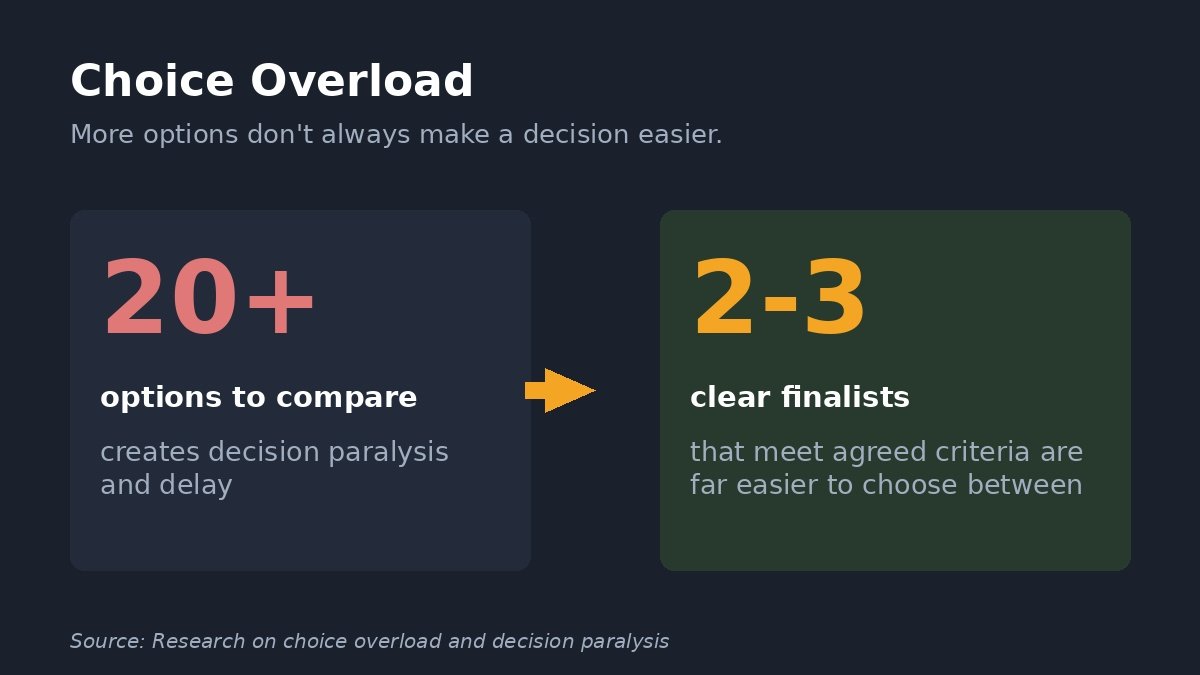
Research into choice overload and decision paralysis has examined how a large number of options can contribute to delayed decisions. That particular study focused on online food-ordering consumers, so it should not be presented as direct evidence about marriage. It does illustrate a broader problem: adding alternatives can increase cognitive burden instead of clarifying the best choice.
This is one of the easiest decision problems to address practically. Instead of asking your husband to select from twenty possibilities, reduce the choice to two or three that meet agreed criteria.
For example, instead of asking, “Which hotel should we book?” you might first agree that the hotel must be under a certain price, within fifteen minutes of the destination, and have strong recent reviews. Once those criteria eliminate most options, the final choice may become considerably easier.
The purpose is not to make the decision for him. It is to remove irrelevant complexity.
6. Stress, Burnout, or Low Mood May Be Making Decisions Harder
If your husband used to make decisions normally and has recently become unusually indecisive, the change itself matters.
Stress, exhaustion, depression, and other forms of psychological strain can affect concentration, motivation, confidence, and judgment. Someone who is overwhelmed at work or emotionally depleted may have far less capacity left for decisions at home, even when the decisions appear simple to someone else.
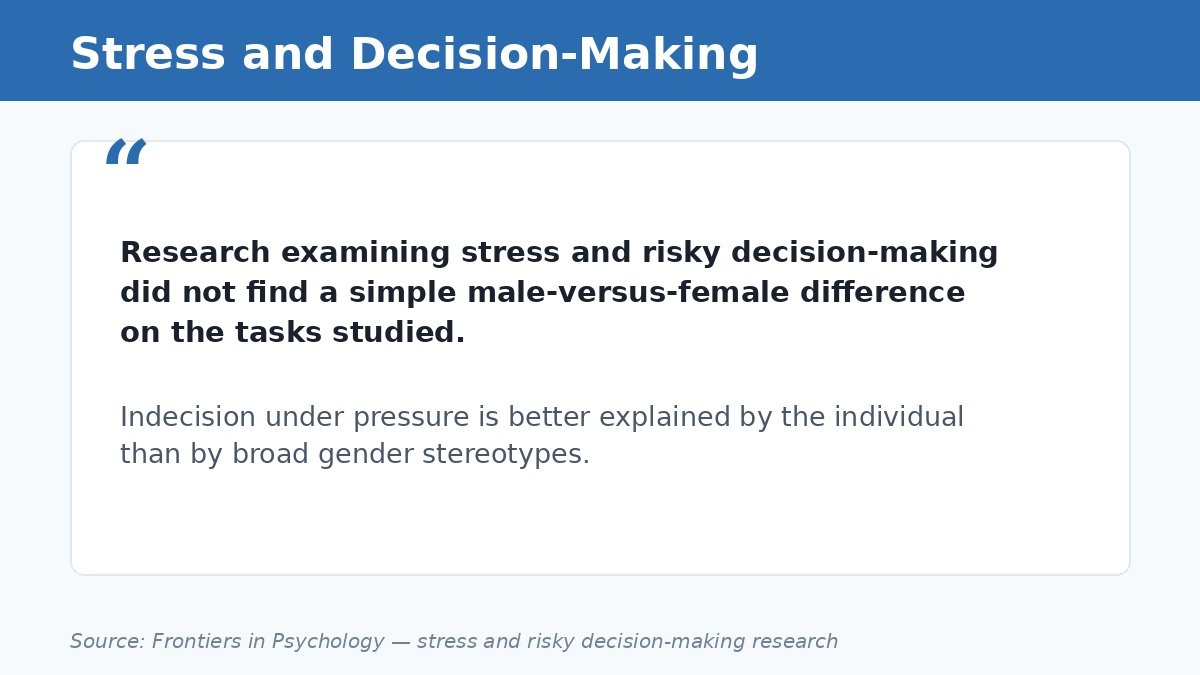
This does not mean every indecisive husband is depressed, nor does it mean men have one predictable response to stress. Research examining stress and risky decision-making in men and women found a more complicated picture than simple gender stereotypes suggest. On the tasks studied, the researchers did not find a straightforward male-versus-female difference in risky decision-making.
That finding reinforces an important point: avoid assuming that indecision is simply “how men are.” Look at the individual.
If indecision appears alongside persistent sadness, anxiety, exhaustion, sleep changes, loss of interest, irritability, difficulty concentrating, withdrawal, or a broader decline in functioning, the problem may deserve assessment by an appropriate healthcare or mental-health professional rather than another argument about who chooses dinner.
7. You May Have Different Decision-Making Styles
Some relationship conflict around decisions is not about whether either person can decide. It is about how quickly each person expects the process to happen.
One spouse may decide quickly based on a few important criteria. The other wants additional information, time to compare alternatives, or an opportunity to think privately before answering.
To the faster decision-maker, the slower spouse looks indecisive. To the slower spouse, the faster partner looks impulsive.
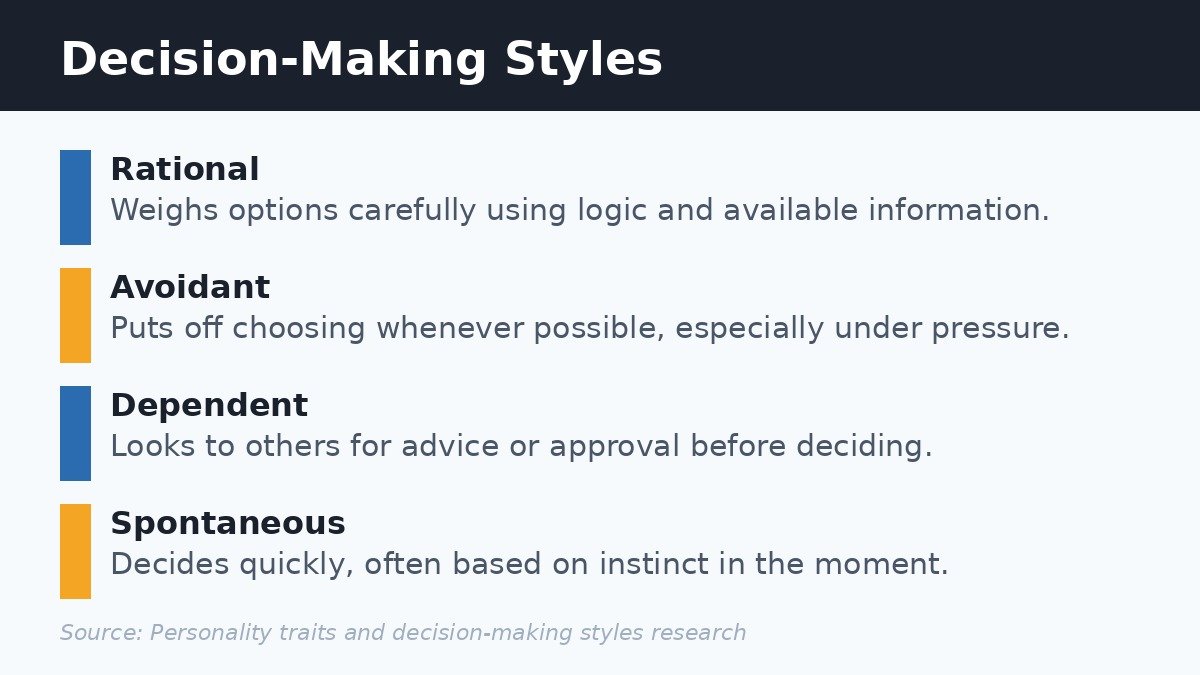
Research on personality traits and decision-making styles supports the idea that people differ meaningfully in the way they approach decisions. Traits such as cautiousness, planning, flexibility, emotional orientation, and analytical tendencies can affect how a person reaches a choice.
Neither style is automatically better. Speed matters when delay has a cost. Deliberation matters when the consequences are substantial.
The practical question is whether your husband’s process eventually produces a decision. Wanting twenty-four hours to think about a major purchase is not the same as avoiding it for six months.
Couples do better when they agree not only on what needs to be decided but on when the decision needs to be made. That allows the more deliberate partner room to think without giving indecision unlimited time.
8. The Relationship May Have Trained Both of You Into This Pattern
This section can be uncomfortable because chronic decision imbalance is not always created by one partner alone.
Sometimes one spouse is naturally quicker, more organized, or more particular. She starts handling decisions because waiting feels inefficient. She researches the purchase, books the appointments, plans the vacation, chooses the school activity, organizes the repair, and resolves the scheduling conflict.
At first, this may feel easier for everyone.
Eventually, however, the pattern can become institutionalized. She expects to handle things because she always has. He expects her to handle them because she usually does. When he finally chooses something, she may redo the research, challenge the choice, or take over because his process is different from hers.
The lesson he receives is that participating creates more conflict than stepping aside.
A practical relationship source discussing indecisiveness and decision roles within couples describes how decision-making can become divided according to established relational roles. This is not peer-reviewed research, so it should be understood as clinical commentary rather than scientific proof. The pattern itself is nevertheless worth examining.
If you want your husband to take more ownership, there may need to be enough room for him to make decisions differently from the way you would make them. This is a core part of what accountability coaching works to rebuild — a man’s confidence in his own follow-through, not just his ability to promise change.
Shared responsibility does not mean one person chooses and the other audits.
9. He May Not Consider the Decision Important
There is another possibility that couples often overlook: your husband may genuinely not care which option is chosen.
If you ask whether he wants Italian or Thai food and both sound equally acceptable, “Whatever you want” may be an honest answer rather than an avoidance strategy.
The difficulty arises when one spouse treats each decision as minor while the other finds having to make hundreds of minor decisions exhausting.
Each individual choice may be unimportant, but the cumulative mental load is not.
This is why telling your spouse, “I genuinely don’t care” does not always solve the problem. Someone still has to evaluate the options and make the choice. If that person is always the same partner, the workload remains unequal even when the decisions themselves are small.
The solution is often ownership rather than preference. Your husband does not need to care deeply about which restaurant you visit to take responsibility for choosing one this week.
Couples can divide recurring low-stakes decisions intentionally. One person chooses Friday dinner. The other plans Saturday. One handles hotels. The other handles transportation. The point is not mathematical equality in every task, but a system in which neither person becomes the permanent manager of all choices.
When Indecision Really Is a Refusal to Take Responsibility
Not every case has a deeper psychological explanation.
Sometimes a person simply does not want the responsibility that accompanies making a decision.
The distinction becomes clearer when your husband has enough information, enough time, and a reasonable ability to choose, yet repeatedly pushes the decision back to you because he does not want to own the consequences.
Pay particular attention to what happens after you decide. If he refuses to participate beforehand but criticizes the result afterward, the problem is no longer merely indecision. He is retaining the right to judge a decision while declining responsibility for making it.
The same concern applies if he routinely leaves difficult parenting, financial, household, or family decisions to you while participating freely in choices he personally enjoys. Selective indecision can reveal something different from generalized difficulty deciding.
Responsibility in a marriage does not require both partners to participate equally in every decision. It does require a reasonably fair distribution of the work and consequences involved in running a shared life.
If one partner repeatedly absorbs the uncertainty, research, planning, and emotional burden while the other waits for an outcome, resentment is a predictable result.
What to Do When Your Husband Won’t Make Decisions
The most effective response depends on why the decision-making problem exists, but the strategies below are useful across different causes.
Identify the Pattern Instead of Arguing About Personality
Avoid turning “You didn’t make this decision” into “You can never make a decision.” Global labels encourage defensiveness and rarely clarify the problem.
Instead, identify where the pattern occurs. Perhaps he makes work decisions easily but avoids financial ones. Maybe he can choose quickly when there are two options but becomes paralyzed when there are twenty. Perhaps the problem appears mainly when he thinks you will disagree.
Specific patterns produce better solutions than character judgments.
Give the Decision a Clear Owner
Some decisions become exhausting because both partners are waiting for the other person to take final responsibility.
Try deciding explicitly who owns the choice. If it is your husband’s decision, let it genuinely be his within agreed limits.
That means resisting the temptation to ask him to choose and then repeatedly overrule his choices because you would have selected something else.
If you already know that only one answer will satisfy you, it may be more honest to make that particular decision yourself rather than requesting participation that is not actually allowed to influence the outcome.
Limit the Options
When choice overload is part of the problem, reduce the field. Agree on the most important criteria first and eliminate options that do not meet them.
Instead of comparing twenty cars, agree on budget, size, reliability requirements, and two or three models worth serious consideration. Instead of examining dozens of vacation rentals, establish location, price, and essential amenities before reviewing finalists.
This does not eliminate responsibility. It makes the decision cognitively manageable.
Set a Reasonable Deadline
A decision without a deadline can become an indefinite research project.
Major choices deserve time, but they also need an endpoint. Agree that you will collect information until a particular day and make the best choice available then.
A deadline changes the question from “Have we reached certainty?” to “Do we have enough information to make a reasonable decision?”
Agree on the Criteria Before Comparing Solutions
Couples often argue about options before agreeing on what actually matters.
If you are choosing a home, one spouse may prioritize commute while the other prioritizes space. If you do not discuss those priorities first, every house becomes an argument about the house rather than a conversation about competing values.
Decision criteria make tradeoffs visible. Once you know what matters most, choosing becomes easier.
Allow Imperfect Outcomes
If every imperfect decision becomes evidence that the person who chose was wrong, avoidance becomes rational.
Couples need a shared understanding that reasonable decisions sometimes produce disappointing outcomes. The restaurant might be bad. The appliance might require repair. The vacation destination might not live up to expectations.
A poor outcome is not automatically proof of poor judgment.
Separate Preference From Responsibility
Your husband does not need a strong preference in order to take responsibility for a choice.
If he genuinely does not care which option is selected, he can still choose one because decision-making itself is part of the shared workload.
This small distinction can reduce a surprising amount of resentment.
Discuss the Burden, Not Just the Decision
If the real problem is that you feel responsible for everything, say that directly.
The conversation is no longer about whether he wants chicken or steak. It is about the cumulative experience of having to notice, research, initiate, and resolve countless decisions without enough participation.
That is a relationship conversation about responsibility and mental load, not a debate about whether one person is naturally more decisive.
What Usually Makes the Pattern Worse
Taking over every decision may feel efficient in the short term, but it can reinforce the exact passivity you resent. If your husband learns that waiting long enough guarantees that you will eventually choose, there is little pressure for the pattern to change.
Mocking indecision is similarly unhelpful. Calling him weak, incapable, childish, or “not a leader” introduces shame without improving decision quality. If fear of error or low confidence already contributes to the problem, humiliation generally makes choosing more threatening.
Another common mistake is requesting a decision while sending the message that only your preferred answer will be accepted. Asking for input and then aggressively challenging every choice teaches the other person that participating is pointless.
Finally, do not diagnose him from an article. Anxiety, depression, personality differences, conflict avoidance, learned relationship roles, and deliberate irresponsibility are different explanations. A blog post can help identify possibilities, but it cannot determine which one applies to an individual person.
When Professional Help Makes Sense
Occasional indecision does not require counseling. Difficulty choosing is part of ordinary life, particularly when decisions are complex or consequential.
Professional support becomes more reasonable when the pattern is chronic, causes significant conflict, prevents necessary decisions from being made, or represents a substantial change from the person’s previous functioning.
If indecision occurs alongside persistent sadness, anxiety, exhaustion, reduced motivation, sleep problems, difficulty concentrating, social withdrawal, substance use, or another significant psychological concern, an appropriately qualified healthcare or mental-health professional should evaluate the broader picture.
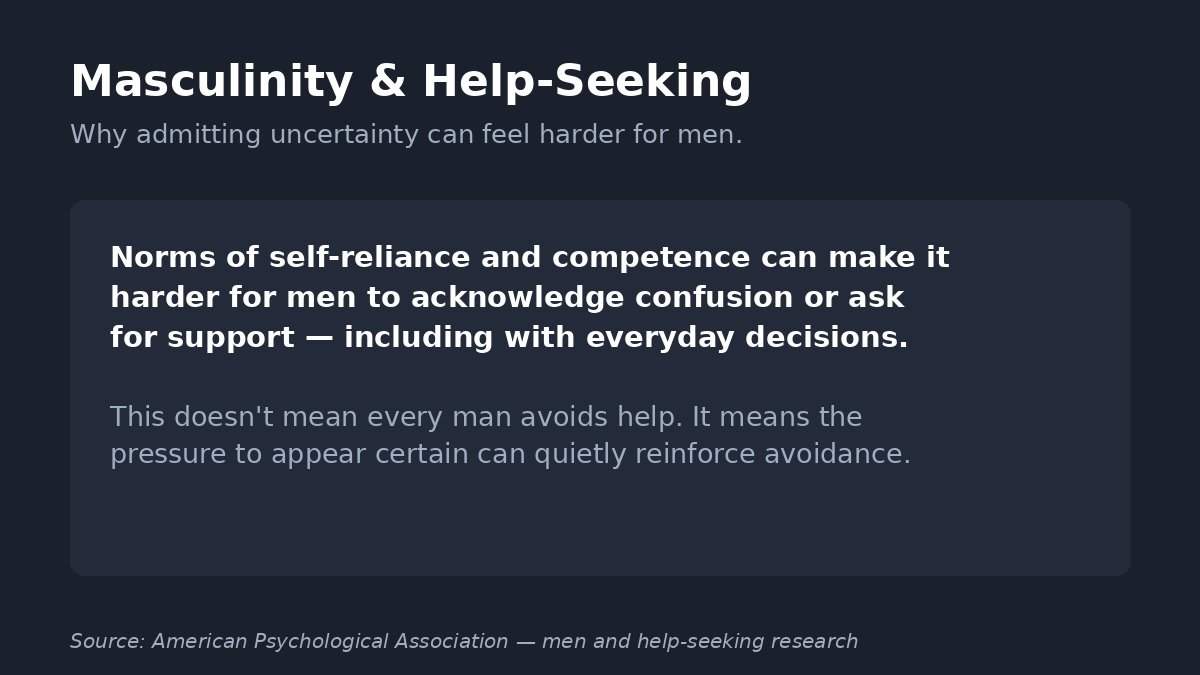
Research on men, masculinity, and the context of help-seeking has examined how expectations of self-reliance and masculine norms can sometimes make men less likely to seek psychological help. That does not mean every man avoids help or that masculinity is inherently harmful. It does suggest that a man who believes he should already know the answer may find it difficult to admit when he does not.
Couples counseling can also be useful when the main problem is the relationship pattern itself: one spouse overfunctions, the other withdraws, resentment builds, and conversations about responsibility repeatedly become arguments.
Coaching serves a different role. STRONG Men Coaching works with generally functioning men on accountability, decision-making, confidence, relationships, personal responsibility, career direction, and turning intentions into consistent action. See the full range of coaching options to find the right fit. Anthony is a life coach, not a licensed therapist, and coaching does not diagnose or treat mental-health conditions.
Ready to Build the Confidence to Decide and Follow Through?
If your husband recognizes that avoidance or lack of follow-through is becoming a recurring problem and wants structured support changing it, a coaching conversation can help him build the confidence, accountability, and decision-making skills to show up differently in your marriage.
Frequently Asked Questions About a Husband Who Won’t Make Decisions
Why won’t my husband make decisions?
A husband may struggle to make decisions because of fear of making the wrong choice, concern about being blamed, low confidence, inadequate information, conflict avoidance, too many options, stress, low mood, or an established relationship pattern in which his spouse normally decides.
Some people also have naturally more cautious or analytical decision-making styles. The pattern and context are more informative than assuming one explanation applies to every husband.
Is an indecisive husband avoiding responsibility?
Sometimes, but not always. A person can genuinely struggle with uncertainty or confidence without deliberately avoiding responsibility.
Avoidance becomes more likely when he has adequate information and time but repeatedly forces you to make the decision, then criticizes the outcome or refuses to share the consequences.
Why does my husband say “whatever you want” all the time?
He may genuinely have no preference, may believe you care more about the decision, may be avoiding conflict, may lack confidence in his judgment, or may have learned that you will make the final choice regardless.
The phrase itself tells you less than what happens in the rest of the relationship.
Why is my husband decisive at work but not at home?
Work and home can involve very different decision structures. At work, he may have clearly defined authority, criteria, expertise, deadlines, and professional distance from the outcome. At home, decisions may involve emotional consequences, competing preferences, or fear of disappointing someone he loves.
It is also possible that a longstanding division of roles has developed in which he expects his partner to handle domestic decisions.
Can anxiety make someone unable to make decisions?
Anxiety can make decisions more difficult when a person becomes highly focused on possible negative outcomes or seeks certainty that is impossible to obtain.
Persistent or severe anxiety should be evaluated appropriately rather than assuming every form of indecision is merely a personality trait.
Can depression cause indecisiveness?
Depression can affect concentration, motivation, energy, and confidence, all of which can make decision-making more difficult. If indecision represents a significant change and occurs alongside persistent sadness, withdrawal, low energy, loss of interest, or other concerning symptoms, professional assessment is appropriate.
Can stress affect decision-making?
Yes. Stress can affect attention, judgment, and risk processing, although research does not support a simple rule that all men or all women respond to stress in the same way.
Research on risky decision-making under stress illustrates the complexity of the relationship between physiological stress responses and decision behavior.
How do I get my husband to make more decisions?
Start by giving specific decisions clear ownership, reducing unnecessary options, agreeing on important criteria, setting reasonable deadlines, and allowing his decision to stand when the outcome falls within agreed boundaries.
If you routinely ask him to decide but then redo, criticize, or reverse the choice, that pattern may also need to change.
Should I stop making decisions for my husband?
You do not need to refuse all help, particularly when a decision is complicated or one partner has greater expertise. The goal is not forced independence. It is shared responsibility.
If you automatically take over whenever he hesitates, however, you may unintentionally reinforce passivity. Decide together which choices he will genuinely own and give him room to make them.
How many options should I give an indecisive person?
There is no universal number, but reducing a large field to two or three reasonable finalists can make choosing easier. Research into choice overload and decision paralysis supports the broader idea that more options do not always make choosing easier.
Is “I don’t care” a valid response to a decision?
Sometimes. A person can genuinely consider several options equally acceptable.
However, not caring strongly about the result does not prevent someone from taking responsibility for making the choice. In relationships where one person carries most of the mental load, alternating low-stakes decisions can help distribute that work more fairly.
When is indecision a relationship problem?
Indecision becomes a relationship problem when necessary choices are chronically delayed, one spouse carries most of the mental load, resentment grows, important financial or parenting matters remain unresolved, or avoiding decisions becomes a way to avoid responsibility.
When should a couple consider counseling over decision-making?
Couples counseling may be worth considering when discussions about decisions repeatedly become conflict, one partner consistently overfunctions while the other withdraws, or the pattern reflects deeper problems with communication, trust, control, or responsibility.
Can coaching help an indecisive man?
Coaching can be useful when a generally functioning man struggles with confidence, accountability, prioritization, decision frameworks, avoidance, or follow-through and wants practical support changing those patterns.
If indecision appears to be driven by a mental-health disorder, significant depression, severe anxiety, trauma, or another clinical concern, a licensed mental-health professional is more appropriate.
The Real Question Is Not Whether He Is “Indecisive”
When your husband won’t make decisions, it is understandable to become frustrated enough to conclude that he is simply refusing to take responsibility. In some relationships, that may ultimately be an accurate description.
But it should not be the starting assumption.
A man can avoid a decision because he is afraid of making a costly mistake, worried about being blamed, uncertain about what matters, overwhelmed by options, exhausted, conflict-avoidant, or accustomed to living in a relationship where somebody else makes the final call.
The behavior may look the same while the mechanism underneath it is very different.
That is why the most productive conversation is rarely, “Why can’t you ever make a decision?” It is a more specific examination of where the pattern appears, what happens when he is asked to choose, and what both partners have learned to do in response.
If he needs more information, define what information is enough. If he fears making the wrong choice, agree that reasonable decisions can still have imperfect outcomes. If too many options overwhelm him, narrow the field. If conflict avoidance is the problem, make disagreement safer. If you have unknowingly become the permanent decision-maker, redistribute ownership instead of simply asking him to “help more.”
And if he has the information, ability, and opportunity to participate but continually leaves difficult choices to you because he does not want responsibility for the result, name that problem accurately as well.
A healthy marriage does not require both people to be equally decisive in every area. It does require both people to participate responsibly in the shared life they are building.
The goal is not to turn your husband into someone who makes every decision immediately. It is to create a relationship in which uncertainty does not automatically become your burden simply because you are the person most willing to act.
Help Him Take the Next Step
If your husband recognizes that avoidance, low confidence, or lack of follow-through is affecting his marriage and wants structured support changing how he makes decisions and takes responsibility, a coaching conversation is a good place to start. If the problem appears connected to significant depression, anxiety, or another mental-health condition, start instead with an appropriately qualified healthcare or mental-health professional.