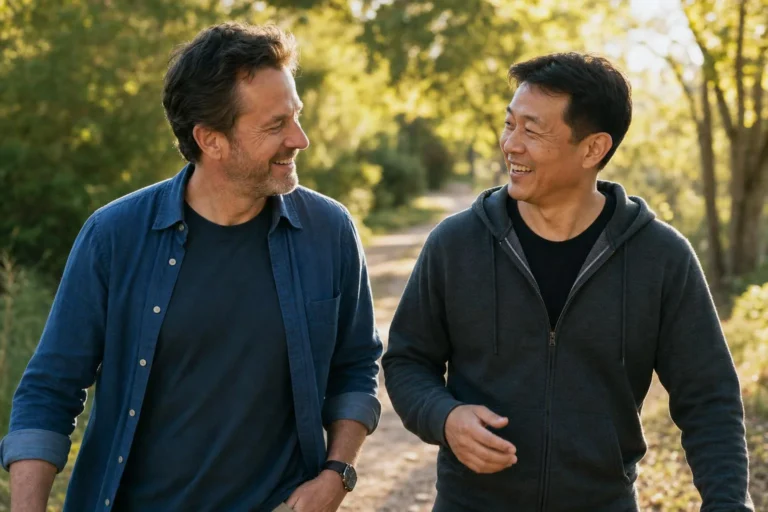
How to Make Friends As a Man
Making friends as a man becomes harder when friendships no longer happen automatically.
When you were younger, you probably didn’t need a strategy. School, sports, the military, college, work, roommates, or your neighborhood repeatedly put the same people around you. Friendship often develops without anyone consciously deciding to build one.
Adult life changes that.
Careers become demanding. Men get married, move, get divorced, raise families, change jobs, and develop different interests. The people you once saw several times a week may eventually become people you talk to several times a year.
If you’re wondering how to make friends as a man, the answer isn’t simply to meet more people.
You need to put yourself in situations where you repeatedly encounter compatible people, take the initiative to move promising relationships beyond those environments, spend time together, and gradually build enough trust and consistency for an acquaintance to become a friend.
That’s a skill. And like most skills, you can get better at it.
Table Of Contents
Why Is It So Hard for Men to Make Friends as Adults?
One reason making friends becomes harder for adult men is simple: many of the environments that once fostered friendships have disappeared.
Think about how many friendships begin when two people repeatedly find themselves in the same place.
School did this.
Sports did this.
The military does this.
College does this.
Certain workplaces do this.
You don’t have to schedule every interaction because the environment keeps bringing you together.
Later in life, that structure often disappears. Work, marriage, divorce, relocation, family responsibilities, and changing interests can gradually reduce the time men spend with potential friends.
And the decline in men’s friendships isn’t just anecdotal.
Research from the Survey Center on American Life found a substantial decline in close friendships among American men. In 1990, 55% of men reported having at least six close friends. By 2021, that figure had fallen to 27%, while 15% of men reported having no close friends at all. (The Survey Center on American Life)
I’ve seen this play out with men I’ve coached.
One was a retired fire chief who had spent 30 years in the fire service. After retiring, he began noticing something about his wife’s life. She had close friends she could call. She had people she regularly did things with.
He realized he didn’t have anything comparable in his own life.
He had spent decades working, leading, serving others, and handling responsibilities. Somewhere along the way, building and maintaining his own friendships hadn’t received the same attention.
I’ve seen another version of this with a man who had two longtime friends from college. The three of them used to watch games together, but over the years, the other two became closer, and he gradually found himself on the outside.
They still crossed paths, so there was never a dramatic ending to the friendship.
He simply stopped being included.
And he never brought it up.
He carried the feeling of being left out without ever telling either man what he was experiencing.
These situations are different, but they reveal the same problem:
Male friendships don’t always end because of a major conflict. Sometimes they disappear quietly while life moves forward.
That’s why telling a 45-year-old man to “go make some friends” can be about as useful as telling someone who wants to get fit to “exercise more.”
Technically correct.
Practically incomplete.
Meeting People Is Not the Same as Making Friends
This is one of the most important distinctions to understand.
You can be surrounded by people and still have very few real friends.
You probably already know men from work, your gym, your neighborhood, professional organizations, sports, martial arts, or other parts of your life.
The better question is:
How many of those relationships ever leave the place where you met?
Someone can remain your “gym friend” for five years because neither of you ever says:
“I’m grabbing something to eat after this. Want to come?”
That small invitation changes the context of the relationship.
You stop being two people who happen to occupy the same place and begin choosing to spend time together.
That’s one of the transitions adult men often miss.
How Does a Male Friendship Actually Develop?
Adult friendship is usually a progression rather than a single event.
A useful way to think about it is:
Common Ground → Repeated Contact → Initiative → Shared Experiences → Trust → Friendship
You don’t meet someone on Tuesday and decide he’s going to become one of your closest friends.
You discover something you have in common.
You see each other again.
Someone initiates.
You start doing things together.
You learn more about each other’s lives.
Trust develops.
Eventually, friendship becomes the natural result.
Research supports the importance of time together. Communication researcher Jeffrey Hall studied adults who had recently relocated as well as first-year college students and found that the amount of time people spent together was associated with increasing friendship closeness. Leisure activities and certain types of everyday conversation also predicted greater closeness. (DOI)
Hall’s research estimated that forming a casual friendship generally required roughly 40–60 hours together, with considerably more time required for increasingly close friendships. These aren’t deadlines or formulas, but they illustrate an important point: getting to know someone takes time. (DOI)
Read Jeffrey Hall’s friendship study
The Friendship Ladder
You can also picture the relationship itself progressing through several stages:
Stranger → Familiar Face → Acquaintance → Activity Partner → Friend → Close Friend
Most relationships won’t travel all the way up that ladder.
They don’t need to.
The mistake is expecting immediate friendship.
Your first goal isn’t to increase your number of friends as quickly as possible.
It’s simply about moving a promising relationship to the next level.
If there’s another guy you regularly talk to at the gym, invite him to grab coffee.
If you occasionally play tennis together, invite him to watch a match.
If you know someone professionally and discover you both enjoy hiking, suggest a hike.
Small invitations create opportunities for deeper friendships.
Where Can Men Make Friends?
The best places to make friends aren’t necessarily the places containing the largest number of people.
There are places that create repeated interaction.
Good possibilities include recreational sports, Brazilian Jiu-Jitsu and other martial arts, running or cycling clubs, a hiking group, volunteer organizations, professional associations, veteran organizations, community groups, classes, religious communities, hobby groups, game nights, and Meetup groups.
Online communities can also help you find people with common interests. Depending on what you’re looking for, that could include local Facebook groups, Discord servers, Meetup, or friendship-focused apps such as Bumble BFF.
The important part is eventually creating meaningful interactions with people, rather than simply collecting online contacts.
The specific activity matters less than three questions:
Do you genuinely enjoy being there?
Do roughly the same people return regularly?
Does the environment naturally create opportunities for conversation or shared experiences?
A one-time networking event might introduce you to 50 people.
A weekly activity might introduce you to eight.
For developing actual friendships, those eight may be far more valuable.
How Do You Start Talking to Other Men?
For some men, finding people isn’t the biggest challenge.
Starting the conversation is.
If you’re uncomfortable talking to strangers, don’t make the first interaction bigger than it needs to be.
You aren’t trying to impress someone or determine whether he’s going to become your best friend.
You’re having a conversation.
Start with the environment you’re already sharing.
At BJJ:
“How long have you been training?”
At a hiking group:
“Have you done this trail before?”
At a professional event:
“What brought you here?”
At the gym:
“Have you tried that class?”
These are ordinary conversation topics, and that’s the point.
Small talk isn’t necessarily meaningless. It can be the doorway to a more interesting conversation.
If you’re overthinking what to say, remember that the other person doesn’t know the script you’re imagining in your head. Ask a question, listen to the answer, and see where the conversation goes.
Not every interaction needs to become something.
You’re simply seeing who is willing to engage.
Over time, ordinary conversations with strangers can become conversations between familiar faces. Familiar faces can become acquaintances. And acquaintances can become friends.
Sometimes you have to take the risk of starting the conversation.
Common Ground Can Start a Friendship, but It Doesn’t Build One
I’ve made some of my closest friendships as an adult.
Two of those friendships developed around experiences and interests we already shared. We’re Marines. We’ve all deployed to combat zones. We also train Brazilian Jiu-Jitsu.
Those similarities gave us a reason to connect, but they weren’t enough on their own to create a friendship.
We trained together.
We spent time together outside of training.
We met each other’s significant others.
We talked about different parts of our lives and gradually became part of each other’s lives.
Eventually, friendships develop their own history: shared experiences, stories, traditions, and inside jokes that mean something because you experienced them together.
That’s an important distinction.
Shared interests can introduce two men. Shared experiences can connect them. But spending time together is what gives the friendship an opportunity to grow.
You also don’t need to reject someone because you don’t have much in common at first.
You don’t need someone with your exact background.
What matters is finding enough common ground to start spending time together—and then actually doing it.
Stop Looking for People Exactly Like You
Compatibility matters.
Similarity isn’t the same thing.
You don’t need a friend who shares your career, politics, background, income, relationship status, and every hobby.
Some of the strongest friendships expose you to different experiences and perspectives.
Instead, pay attention to character.
Does he follow through?
Does he ask questions?
Can he laugh at himself?
Does he seem interested in other people?
Does he show up when he says he will?
Do you enjoy being around him?
Would you want to spend another hour talking to him?
Those characteristics tell you much more about friendship potential than whether your lives are identical.
Take the Initiative
This is where many potential male friendships die.
Two men meet.
They get along.
Both think:
“He’s a good guy. We should hang out sometime.”
Neither does anything.
Six months later, they’re still acquaintances.
Someone has to initiate.
It might as well be you.
And it doesn’t need to sound like you’re formally asking someone to become your friend.
Keep the invitation connected to something you’re already discussing.
“You play tennis? We should hit sometime.”
“I’m grabbing lunch after class. Want to come?”
“A few of us are hiking Saturday morning. You should join us.”
Specific invitations are better than:
“We should hang out sometime.”
The second requires another conversation.
The first can produce a plan.
Men often don’t lose opportunities for friendship because they consciously reject them. They lose them because neither man does anything.
If you want to make more friends, sometimes you have to be the person willing to make the first move.
Don’t Interpret Every “No” as Rejection
Adults have complicated schedules.
Someone declining an invitation doesn’t necessarily mean he doesn’t want to hang out.
Look for patterns instead.
If someone declines but suggests another day, that’s a strong signal that he’s interested.
If you’ve invited him repeatedly and he never reciprocates, proposes another time, or initiates contact, that’s useful information too.
Don’t become resentful.
Don’t keep chasing.
Make the invitation and see who responds.
Then invest more energy in people who demonstrate that they also want the relationship.
Friendship requires some degree of reciprocity.
Do Things Together
Men often connect well through shared activity.
Use that to your advantage.
You don’t necessarily need to sit across from another man and immediately have a deeply personal conversation.
Go do something.
Train.
Hike.
Watch a game.
Lift weights.
Take a road trip.
Build something.
Attend an event.
Grab lunch.
Travel somewhere.
Shared experiences give conversation somewhere to begin.
Over time, the conversation usually expands beyond the activity.
That’s when the relationship starts changing.
Let Conversations Become More Personal
Activities can create opportunities for friendship.
Knowing each other creates depth.
Stanford’s Clayman Institute has highlighted research suggesting that men’s social networks tend to be thinner in depth than women’s, with less frequent emotional disclosure and less reliance on those relationships for support.
That doesn’t mean men need to sit around and talk about their feelings every time they see each other.
It does mean someone eventually has to reveal something real if two men want to develop a closer friendship.
You can start small.
Instead of:
“Work’s good.”
Try:
“Work’s been frustrating lately. I’m actually thinking about making a change.”
Instead of keeping a major life transition entirely to yourself, tell your friend what you’re actually experiencing.
You’re giving the other person an opportunity to know you.
Often, he’ll respond by revealing something about himself.
That’s how trust begins to develop.
Become the Friend You Want to Have
It’s easy to create a list of what you want from friends.
Loyalty.
Reliability.
Honesty.
Support.
Someone who calls.
Someone who shows up.
Someone who remembers what’s happening in your life.
Now turn the list around.
Are you doing those things?
If your friend has a job interview on Tuesday, text him on Tuesday night.
If he tells you his father is sick, check on him.
If you haven’t talked for three weeks, call him.
If you say you’ll be somewhere at 8:00, arrive at 8:00.
Strong friendships aren’t built entirely through extraordinary moments.
They’re usually built through ordinary acts repeated over time.
Reconnect With Men You Already Know
Making friends doesn’t always require starting from zero.
There may already be people in your life who are one phone call away.
Old military buddies.
Former teammates.
College friends.
Former coworkers.
Training partners.
Friends you’ve gradually lost contact with.
Don’t wait for the perfect explanation for why you haven’t spoken.
Send the message.
“Man, I realized it’s been way too long. How have you been?”
Some friendships won’t restart.
Others may feel surprisingly natural.
History creates something new that friendships can’t immediately reproduce: shared experience.
Sometimes Someone Just Has to Make the First Move
I’ve also coached a man who had been carrying the weight of a broken friendship for years.
Something had happened between him and a friend, but it had never really been resolved.
Years passed without either man taking the first step.
I encouraged him to reach out.
When they finally talked, they discovered that much of what had kept them apart had been a misunderstanding.
Years of friendship had been lost while both men remained silent.
That experience reinforced something I’ve seen repeatedly:
Sometimes the hardest part of repairing a male friendship isn’t resolving the original problem. It’s getting one man to make the first move.
If there’s someone you still think about years after a friendship ended, don’t ignore the elephant in the room and automatically assume the relationship is beyond repair.
You may not get the response you hope for.
But one honest conversation can answer a question that silence never will.
Don’t Build Your Entire Social Life Around Your Relationship
A romantic partner can be your closest relationship without becoming your only meaningful relationship.
There’s nothing inherently wrong with relying heavily on your partner. The problem occurs when every other meaningful relationship gradually disappears.
Your partner shouldn’t have to fulfill every social role in your life.
Maintaining friendships gives you relationships built around different parts of who you are.
And if your relationship ends, your career changes, you retire, you relocate, or life suddenly looks different, those relationships can become even more important.
Friendship deserves attention before you desperately need it.
Why Male Friendship Matters for More Than Your Social Life
Friendship isn’t merely about having someone to watch a game with.
Social connection is associated with broader health and well-being.
The U.S. Surgeon General’s advisory on social connection identifies loneliness and social isolation as significant public-health concerns. HHS reports that social isolation is associated with a 29% greater risk of premature mortality, while poor social relationships, loneliness, and isolation have also been associated with increased cardiovascular and other health risks. (HHS.gov)
This doesn’t mean friendship is medicine or that having more friends guarantees better health.
It means human connection matters.
And building meaningful relationships deserves to be treated as an important part of your life, not something you’ll get around to once everything else is finished.
Use the Rule of One
If your social life has become small, don’t try to rebuild it overnight.
Use a simple weekly rule:
One invitation.
One conversation.
One reconnection.
Invite one person to do something.
Have one conversation that goes slightly deeper than usual.
Contact one person you’ve lost touch with.
That’s three intentional actions each week.
Over three months, that creates dozens of opportunities to strengthen your social life.
Not every interaction will produce a friendship.
They don’t have to.
You’re creating opportunities.
How Long Does It Take to Make a Real Friend?
Real friendship takes time.
Jeffrey Hall’s research on friendship development found that time spent together was associated with increasing closeness. His research suggests that approximately 40–60 hours together can move people toward casual friendship, with considerably more time associated with deeper levels of friendship. (DOI)
But don’t turn those numbers into a stopwatch.
The important finding is simpler:
Friendship requires time together.
You meet.
You talk again.
You do something together.
You discover shared interests.
You share more about yourselves.
You help each other.
You create experiences.
Eventually, neither of you needs to decide whether you’re friends.
You just are.
That’s why consistency matters more than intensity.
Common Mistakes Men Make When Trying to Make Friends
Waiting for Other Men to Initiate
If everyone waits, nothing happens. Someone needs to make the first invitation, send the message, or suggest the plan.
Expecting Immediate Chemistry
Adult friendships often develop gradually. Don’t dismiss someone simply because you didn’t immediately feel like you’ve known each other for 20 years.
Only Meeting People Once
Repeated interaction matters. Give yourself opportunities to encounter the same people regularly.
Never Leaving the Original Environment
Your coworker remains your coworker. Your training partner remains your training partner. Your neighbor remains your neighbor.
Moving the relationship into another setting can change it.
Keeping Every Conversation Superficial
People can’t become close to someone they don’t actually know.
You don’t need to overshare, but gradually allow people to see what’s happening in your life.
Assuming Friendship Should Happen Naturally
It did when you were younger because your environment was doing much of the work for you.
As an adult, friendship often requires intention.
What If You Have No Friends Right Now?
Start where you are.
Having few or no close friendships describes your current social situation. It doesn’t determine what your social life has to look like in the future.
You don’t need ten new friends next month.
You need your next interaction.
Your next invitation.
Your next conversation.
Your next “yes.”
Find one environment where you can repeatedly interact with other people.
Show up consistently.
Start conversations.
Pay attention to the people you enjoy being around.
Invite one of them to do something outside that environment.
Start there.
Can You Really Make Close Friends After 40 or 50?
Yes.
You might make one of your closest friends at 38.
Or 47.
Or 56.
There isn’t an expiration date on friendship.
What changes with age is that the conditions that once created friendship automatically may no longer exist.
That means you have to create those conditions yourself.
Put yourself somewhere people gather repeatedly.
Talk to people.
Pay attention to the men you respect and enjoy being around.
Initiate.
Do things together.
Reveal enough of yourself to actually be known.
Follow through.
Then repeat.
Strong Male Friendships Require Intention
The goal isn’t to collect friends.
It’s not about having hundreds of contacts or being surrounded by people every weekend.
It’s about having people in your life who actually know you.
Men who challenge you.
Men who support you.
Men you can laugh with.
Men you can call.
Men you share experiences with.
And men who know you’ll do the same for them.
I’ve seen what happens when men spend decades without building those relationships.
I’ve seen what happens when friends quietly drift apart and nobody says anything.
I’ve also seen what can happen when one man finally picks up the phone.
Friendship doesn’t always take an enormous gesture.
Sometimes it begins with something much simpler.
Someone decides to make the first move.
And sometimes that one decision changes a relationship for years to come.
Free Guide: Build Stronger Male Friendships
Strong friendships don’t simply happen automatically as we get older.
If you’ve realized that you want stronger friendships—or that some important relationships in your life have gradually disappeared—I’ve written a book specifically about this.
Brotherhood Bonds: A Man’s Guide to Making Friends Last a Lifetime explores why male friendships matter, why they often fade, and how men can create, maintain, repair, and strengthen meaningful relationships throughout their lives.
Download your free copy of Brotherhood Bonds and start becoming more intentional about the men you want beside you for the rest of your life.
Frequently Asked Questions About Making Friends as a Man
Why is it hard to make friends as a man?
Making friends often becomes harder for adult men because many environments that once created repeated social interaction—such as school, sports, college, military service, or early career life—disappear. Work, relationships, relocation, and other responsibilities can further reduce opportunities for consistent social contact.
Where can adult men make new friends?
Look for environments built around recurring participation. Sports, martial arts, gyms, hiking groups, volunteer organizations, professional associations, veteran organizations, Meetup groups, hobby groups, community organizations, religious communities, and classes can all provide opportunities to repeatedly interact with the same people.
How do I make friends in my 40s or 50s?
Put yourself in environments where you’ll repeatedly encounter people with compatible interests or values. Start conversations, take the initiative to make specific invitations, spend time together outside the original environment, and allow trust to develop through consistency and shared experiences.
How do I turn an acquaintance into a friend?
Move the relationship beyond the context where you normally see each other. Invite the person to coffee, lunch, a workout, a game, a hike, or another activity. The transition from accidental interaction to intentionally spending time together is an important step toward friendship.
What should I do if I’m always the one initiating?
Don’t judge the relationship based on one declined invitation. Look for patterns. Someone who is interested may decline but suggest another day. If someone repeatedly declines, never proposes another time, and never initiates contact, consider investing more energy in relationships where interest is more reciprocal.
Can an old friendship be repaired after years apart?
Sometimes. The outcome depends on why the relationship ended and whether both people are willing to reconnect. If the friendship still matters to you, reaching out can provide an opportunity for an honest conversation. Silence guarantees that nothing changes; a conversation at least creates the possibility.