
Learning how to find purpose as a man usually does not begin with discovering one dramatic mission that suddenly explains your entire life. Purpose is more often built gradually as your values, abilities, relationships, responsibilities, and daily actions begin pointing in the same direction.
That matters because many men search for purpose as though there is one correct answer hidden somewhere inside them. They expect a moment of certainty in which they finally understand what they were “meant” to do. When that moment never arrives, they assume they are behind, unmotivated, or missing something that other men seem to possess naturally.
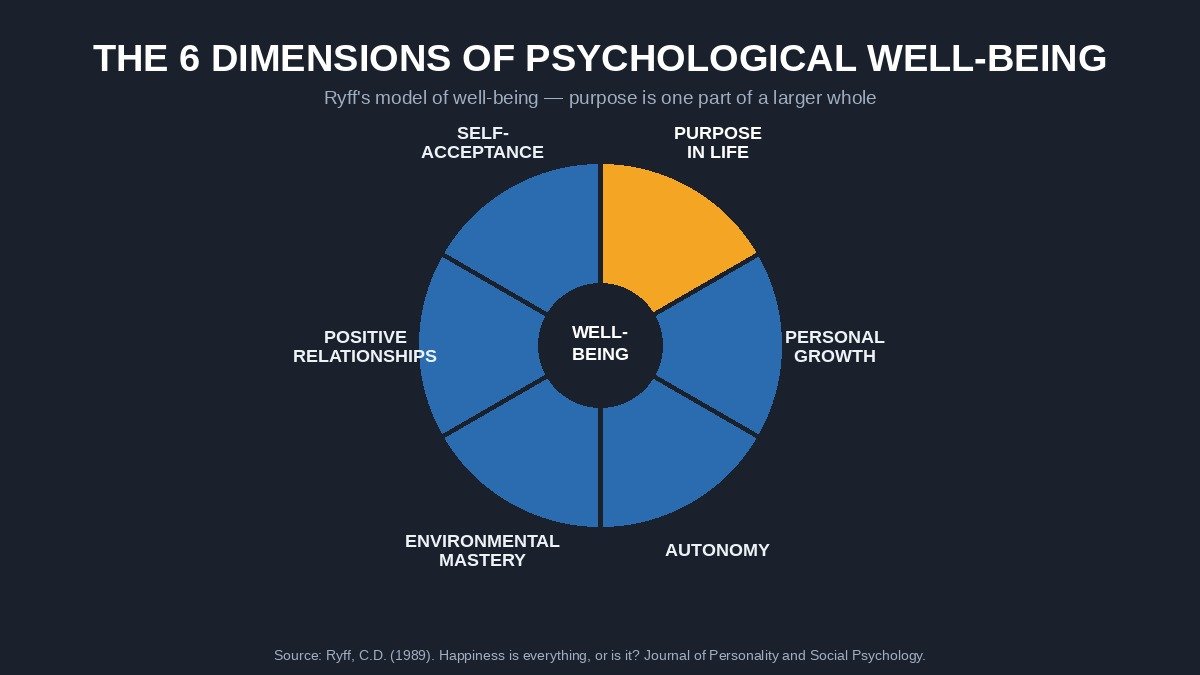
Research on psychological well-being suggests a more useful way to think about the problem. In psychologist Carol Ryff’s influential work on psychological well-being and purpose in life, purpose is not treated as a single grand calling. It is one dimension of a broader healthy life that also includes personal growth, autonomy, environmental mastery, positive relationships, and self-acceptance.
In practical terms, this means purpose is not only about discovering what career you should have or identifying one cause that defines you. It can develop through fatherhood, friendship, service, leadership, craftsmanship, faith, community, health, mentoring, creative work, building something useful, or becoming dependable in a responsibility that matters to you.
If you feel directionless, the goal is not to solve your entire life in one sitting. The goal is to begin building a life in which more of your time, effort, and attention are connected to things you genuinely value.
- Purpose is usually built through values, relationships, competence, contribution, and repeated action rather than discovered in one dramatic moment.
- Career success, money, status, and productivity can support a meaningful life, but they are not automatically the same thing as purpose.
- Research on psychological well-being treats purpose as one part of a broader healthy life that also includes growth, autonomy, self-acceptance, relationships, and the ability to manage life’s demands.
- Relationships and social connection can be part of purpose rather than distractions from it.
- Contribution often creates more durable direction than endless self-analysis because purpose becomes clearer when your abilities are useful to someone or something beyond yourself.
- You do not need perfect certainty before acting. Small purpose experiments can reveal what deserves a larger place in your life.
- What Does It Mean to Have Purpose?
- 1. Stop Equating Purpose With Achievement
- 2. Identify the Values You Want Your Life to Express
- 3. Look for the Intersection of What Matters, What You Can Do, and What You Can Contribute
- 4. Include Relationships in Your Definition of Purpose
- 5. Move From Consumption to Contribution
- 6. Build Competence and Responsibility
- 7. Treat Dissatisfaction as Information, Not a Verdict
- 8. Run a 30-Day Purpose Experiment
- Can Your Purpose Change Over Time?
- Purpose Is Not the Same Thing as Productivity
- Purpose Does Not Require Loving Every Day
- Purpose and Responsibility Often Develop Together
- When Lack of Purpose May Be More Than a Direction Problem
- Frequently Asked Questions About How to Find Purpose as a Man
What Does It Mean to Have Purpose?
Purpose is a sense that your life has direction and that your effort is connected to something you consider worthwhile. It gives your decisions a larger context. Instead of simply asking what feels good today or what produces the fastest reward, you begin evaluating choices according to what kind of life you are trying to build.
This is why purpose should not be reduced to passion. Passion can be temporary, emotionally intense, and highly dependent on circumstances. Purpose can remain meaningful even when the work itself becomes difficult, repetitive, or inconvenient.
A father may not feel passionate every time he helps his child through a problem, yet fatherhood may remain one of the most purposeful parts of his life. A business owner may not enjoy every administrative task, but building something useful for customers and employees may still provide direction. A man caring for an aging parent may experience stress and sacrifice while also believing deeply that the responsibility matters.
Ryff’s research on purpose in life as a dimension of psychological well-being places purpose alongside other dimensions such as positive relationships, environmental mastery, autonomy, personal growth, and self-acceptance. That framework is useful because it prevents purpose from becoming another achievement contest.
A meaningful life is not merely one in which you accomplish more. It is one in which your goals, relationships, growth, responsibilities, and values begin forming a coherent direction.
A practical working definition might be:
Purpose is using who you are and what you can develop to serve what you value, alongside people and responsibilities that matter to you.
That definition does not require fame, wealth, certainty, dominance, or a perfect career. It requires intentionality.
1. Stop Equating Purpose With Achievement
One of the most common mistakes men make when trying to understand how to find purpose as a man is assuming that purpose will arrive after enough achievement.
The formula sounds reasonable: get the promotion, make more money, build the business, buy the house, improve the body, earn respect, and eventually life will feel meaningful. Achievement can certainly produce satisfaction, opportunity, confidence, and security. The problem is assuming it can answer every question about meaning.
A man can achieve something he spent ten years pursuing and still discover that the accomplishment did not provide the internal shift he expected. The promotion becomes normal. The income target moves. The new house becomes the house he lives in every day. The applause fades, and another target appears.
This does not mean ambition is shallow. Ambition becomes a problem when achievement is expected to carry the entire burden of identity and purpose.
Ask yourself whether the goals you are pursuing would still matter if nobody admired you for accomplishing them. If the answer is no, the goal may be more closely connected to status than purpose.
Useful questions include:
- If nobody praised me for this, would I still care about it?
- What am I pursuing because I genuinely value it?
- Which goals am I chasing mainly because I believe a successful man is supposed to want them?
- What would still matter to me if my job title disappeared tomorrow?
- What do I want my effort to contribute to beyond my own image?
A life can look successful externally while feeling hollow internally when achievement becomes disconnected from personal values. Purpose is better understood as meaningful direction than as continually winning more.
2. Identify the Values You Want Your Life to Express
If you are trying to learn how to find purpose as a man, values are one of the best places to start because purpose needs something to point toward.
Values are not goals. A goal can be completed. A value is a quality you continue trying to express through your behavior.
You can finish a marathon, but health may remain a value. You can complete a project, but craftsmanship may remain a value. You can help a child through one difficult period, but fatherhood, love, responsibility, or family may remain values throughout your life.
Choose five qualities you want your life to express. Possibilities might include:
- Integrity
- Courage
- Love
- Responsibility
- Freedom
- Mastery
- Service
- Creativity
- Adventure
- Wisdom
- Faith
- Family
- Leadership
- Friendship
- Contribution
Then make the exercise harder. Rank them.
The purpose of ranking is not to create a permanent hierarchy that can never change. It is to force clarity. Many people say they value family, health, friendship, work, freedom, adventure, growth, service, and financial security equally. Real life rarely allows everything to receive equal time and attention.
The most revealing step is comparing your stated values with your calendar, bank account, and recurring behavior. If you say relationships matter but every available hour goes to work, the calendar is expressing a different hierarchy. If health matters but you continually trade sleep for productivity, your behavior is communicating something your intentions are not.
A useful question is:
What kind of man do I want my actions to prove that I am?
That question moves purpose away from identity labels and toward behavior. You do not become responsible by describing yourself as responsible. You become responsible through repeated choices that support the value.
3. Look for the Intersection of What Matters, What You Can Do, and What You Can Contribute
Purpose often becomes clearer when several parts of life begin overlapping. Instead of waiting for one perfect calling, look for the intersection of four questions.
What do you genuinely care about?
Which problems, people, communities, ideas, or responsibilities consistently matter to you? What bothers you enough that you wish somebody would improve it? What kind of work feels worthwhile even when it is difficult?
What are you good at—or willing to become good at?
Purpose does not require starting with exceptional talent. It does require some relationship with capability. Consider skills, experience, temperament, knowledge, and strengths you already possess, along with abilities you would be willing to develop over several years.
Where can those abilities become useful?
Meaning often becomes stronger when competence serves something beyond the self. A skill becomes more purposeful when it solves a problem, teaches someone, supports a family, builds something worthwhile, protects something valuable, or improves another person’s life.
What are you willing to practice consistently?
This final question prevents purpose from becoming fantasy. Many ideas sound inspiring for twenty minutes. A meaningful direction has to survive ordinary Tuesdays.
You may love the idea of being a writer but dislike writing. You may love the image of entrepreneurship but dislike uncertainty, selling, and operational responsibility. You may admire people who mentor younger men without actually wanting to commit your own time to mentoring.
That information is useful. Purpose should not be built only around an attractive identity. It needs enough compatibility with your actual temperament and willingness to act.
If you are uncertain, test possible directions instead of analyzing them indefinitely. Mentor one person. Volunteer twice a month. Build a small project. Take a course. Help organize something in your community. Teach a skill you already possess.
Purpose often becomes clearer through engaged activity because action produces information that introspection alone cannot.
4. Include Relationships in Your Definition of Purpose
One of the most important corrections to many conversations about purpose for men is recognizing that relationships are not secondary to a meaningful life.
A man can become so focused on achievement, independence, or productivity that he begins treating relationships as things to manage around the “important” work. Yet for many people, the roles that ultimately carry the greatest meaning are relational: husband, father, friend, brother, son, mentor, teammate, neighbor, or member of a community.
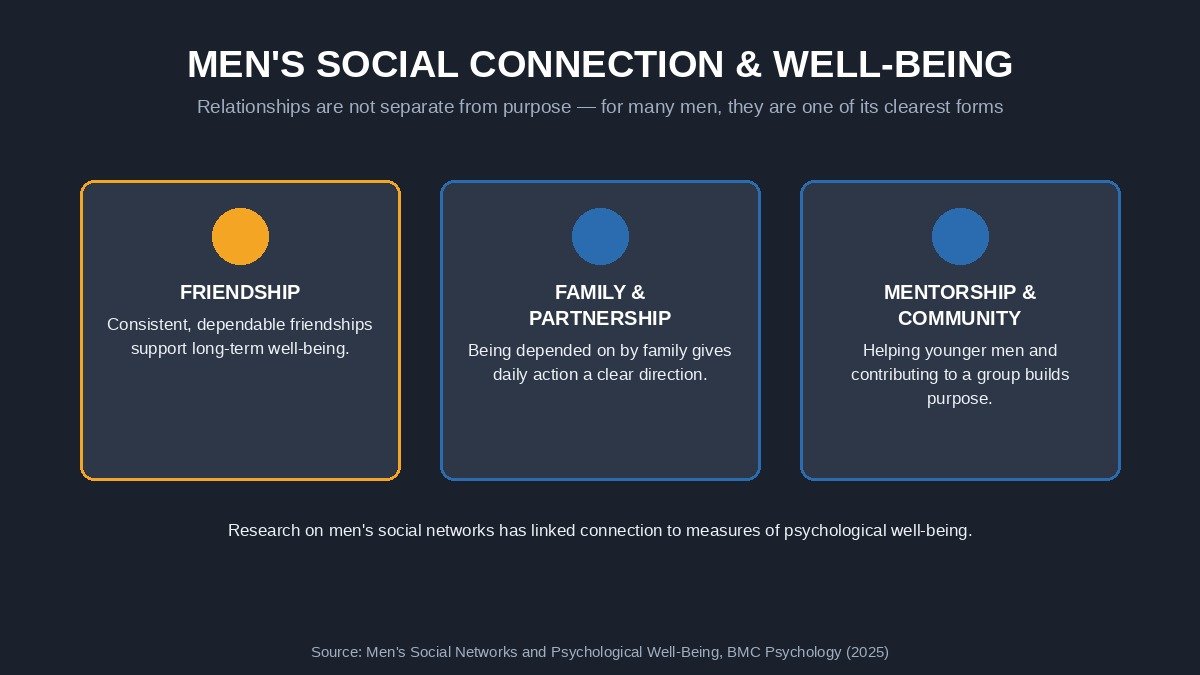
Recent research on men’s social networks and psychological well-being examined associations between social connection and dimensions of well-being among men. The study found that men’s social networks were related to aspects of psychological well-being, reinforcing the broader idea that connection is not merely an optional addition to a meaningful life. Building that kind of network often starts with the same basics covered in how men build real friendships with other men — purpose and connection tend to reinforce each other.
This fits naturally with Ryff’s model, where positive relationships exist alongside purpose, autonomy, growth, mastery, and self-acceptance rather than outside them.
If you are trying to figure out how to find purpose as a man, ask relational questions as seriously as career questions:
- Who benefits from my presence?
- Who can reasonably depend on me?
- Which relationships deserve more effort than I currently give them?
- What kind of husband, father, friend, brother, or mentor do I want to become?
- Who do I want beside me while I build the next stage of my life?
Purpose becomes distorted when it requires sacrificing every meaningful relationship in order to prove that your work matters.
A career can be purposeful. So can raising children well. So can becoming the friend who shows up, the son who helps his parents through a difficult stage of life, or the older man who helps someone younger avoid mistakes he had to learn the hard way.
Close relationships are not necessarily distractions from purpose. For many men, they are one of its primary forms.
5. Move From Consumption to Contribution
Another practical way to find purpose is to examine how much of your life is organized around consumption compared with contribution.
Modern life makes consumption almost effortless. There is always another series to watch, another product to buy, another feed to scroll, another game to play, another podcast to hear, another opinion to consume, or another piece of content promising to tell you how to improve yourself.
None of those things is inherently bad. Rest, entertainment, and enjoyment have legitimate places in life. The problem is that consumption by itself rarely gives a person a durable sense that his life matters.
Contribution changes the direction of attention. Instead of asking only what life can provide for you, you begin asking what you can provide through your presence, effort, ability, or experience.
Contribution can include:
- Teaching or mentoring someone
- Caring for family members
- Volunteering in your community
- Building or repairing something useful
- Helping younger men develop
- Creating art, writing, tools, or knowledge
- Building a business that genuinely solves a problem
- Protecting something valuable
- Becoming dependable in a role that matters
Contribution does not have to be impressive or public. A man does not need thousands of followers or an organization bearing his name before his life can be useful.
Helping one child become more secure, one employee become more capable, one friend get through a difficult period, or one community function a little better can be meaningful precisely because the contribution is real.
This is also a useful antidote to endless purpose-searching. Instead of continually asking, “What am I meant to do?” ask, “Where can I be useful this week?”
Repeated usefulness often reveals what deserves more of your life.
6. Build Competence and Responsibility
Purpose becomes more stable when it is supported by capability.
It is difficult to feel much direction when you continually experience life as something happening to you. Developing competence changes that relationship because it gives you a greater ability to act on the things you value.
This is where the idea of environmental mastery becomes useful. In Ryff’s model of psychological well-being and environmental mastery, well-being includes a sense that you can manage important aspects of your environment and life circumstances.
You cannot control everything, but becoming more capable increases the range of situations in which you can respond effectively.
That might mean:
- Improving your physical health
- Learning a professional or technical skill
- Becoming financially more responsible
- Improving emotional regulation
- Learning to communicate more effectively
- Becoming a more capable parent
- Learning to lead a team
- Completing a difficult project
- Learning how to maintain friendships
- Taking responsibility for something you have avoided
Competence also makes purpose less abstract. A man may value helping others, but developing counseling, coaching, teaching, medical, technical, or leadership skills determines how effectively he can translate that value into useful action.
This is why endless reflection can eventually become another form of avoidance. You do not need to understand your entire purpose before becoming more capable.
Choose one meaningful area and improve your ability to contribute within it.
Purpose often catches up.
7. Treat Dissatisfaction as Information, Not a Verdict
Feeling restless, empty, bored, or directionless does not automatically mean something has gone terribly wrong with your life.
Sometimes dissatisfaction is information.
A career that once fit may no longer fit. Children grow older and change the role of parenthood. A marriage changes. A business succeeds and removes the challenge that once made it exciting. A man reaches a financial goal and realizes he spent fifteen years assuming the number itself would make the next chapter obvious.
The mistake is either ignoring persistent dissatisfaction completely or treating every uncomfortable emotion as an instruction to destroy your current life and begin again.
A better response is curiosity.
Ask:
- What part of my life currently feels the most hollow?
- What am I doing mainly because other people expect it from me?
- When have I felt most useful, engaged, or alive?
- What responsibilities am I avoiding?
- Which part of my life has become almost entirely about maintaining an image?
- What would I change if I were less worried about disappointing other people?
- What do I want the people closest to me to remember about the way I lived?
These questions should not be answered quickly for the sake of completing an exercise. The patterns across your answers matter more than any individual response.
Research focusing specifically on men has also connected purpose and the ability to manage life demands with psychological well-being. A study examining shame, depressive symptoms, environmental mastery, and purpose in life among men found that environmental mastery and purpose were relevant to the relationship between shame and depressive symptoms.
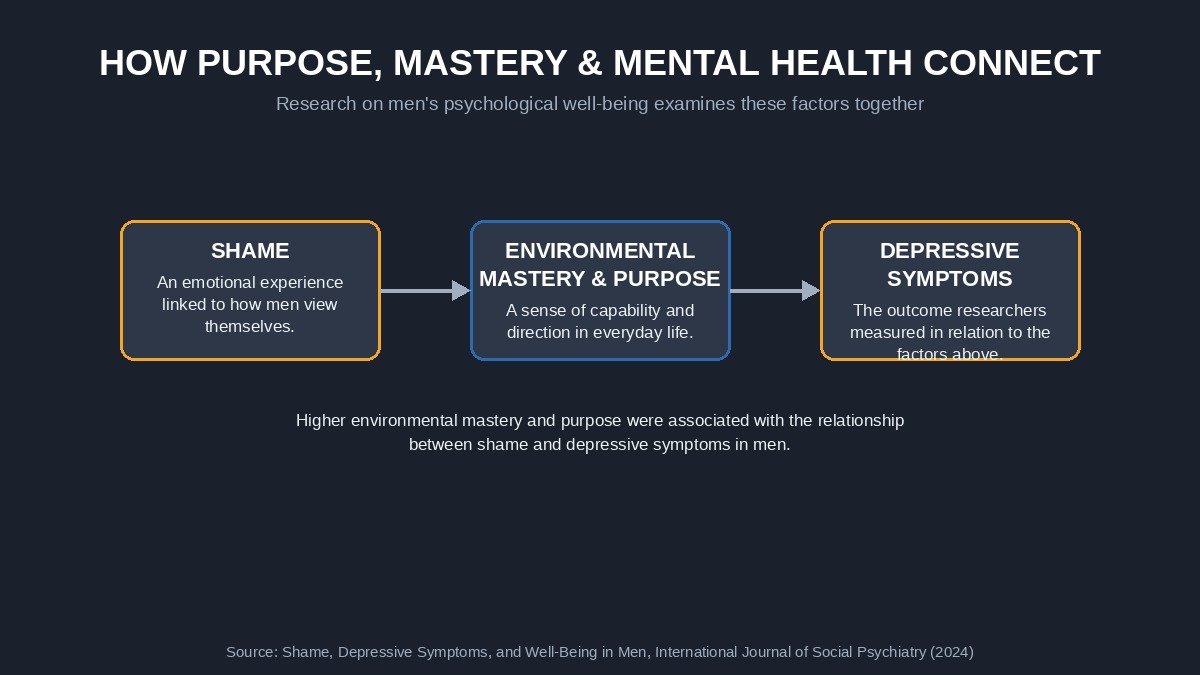
That does not mean a lack of purpose automatically causes depression, or that purpose can replace mental-health treatment. It does support the broader idea that feeling directed and capable can matter significantly within men’s psychological well-being.
Persistent dissatisfaction deserves attention. It does not automatically deserve panic.
8. Run a 30-Day Purpose Experiment
One of the best answers to how to find purpose as a man is to stop demanding a lifetime answer and run a short experiment.
Choose one area that seems potentially meaningful and commit to it for thirty days. The experiment should be substantial enough to produce information but small enough that you can actually complete it.
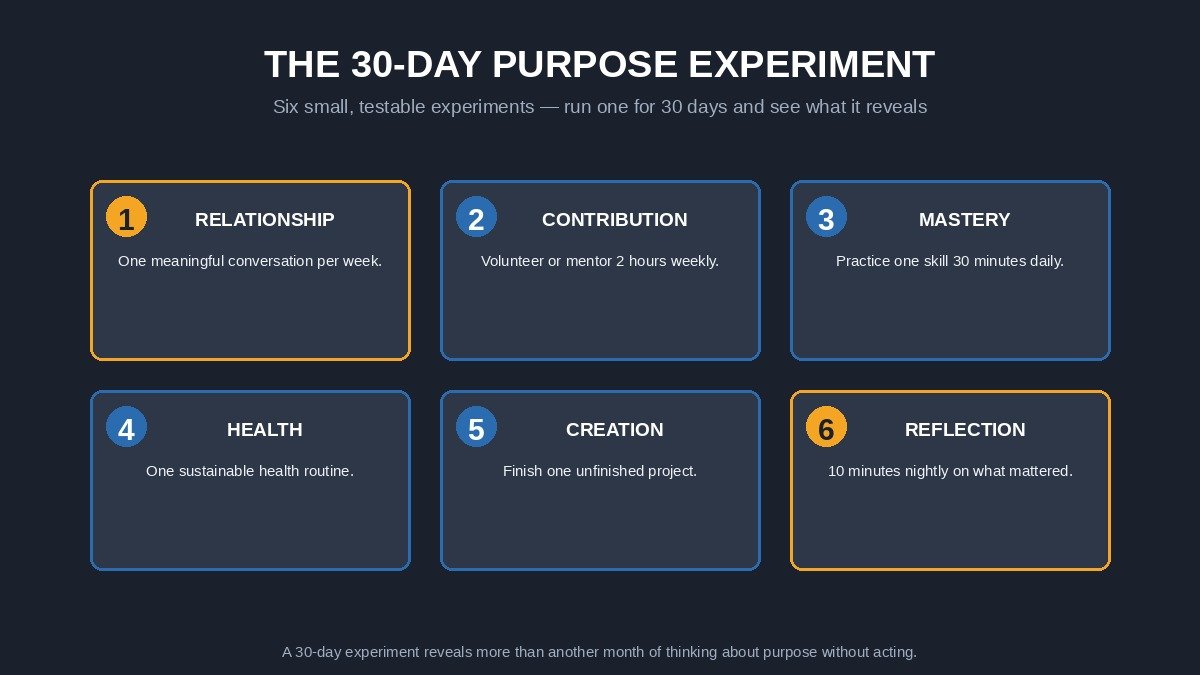
Relationship experiment
Contact one friend or family member each day or intentionally schedule one meaningful conversation every week. Pay attention to whether greater connection changes the way your life feels.
Contribution experiment
Volunteer, mentor, or help someone for two hours each week. Do not evaluate the activity according to whether it makes you feel extraordinary. Ask whether you feel useful.
Mastery experiment
Practice one valuable skill for thirty minutes a day. Choose something that increases your ability to contribute rather than something selected solely for entertainment.
Health experiment
Create one sustainable health routine involving sleep, strength training, walking, nutrition, or another relevant behavior. Notice whether greater physical capability changes your engagement with the rest of life.
Creation experiment
Finish something. Write the article, build the table, launch the small project, repair the neglected space, or create the resource that could be useful to someone else.
Reflection experiment
Spend ten minutes each evening recording what felt meaningful that day. Do not record only what felt pleasurable. Include moments in which something was difficult but worthwhile.
At the end of the thirty days, ask:
- Did this make me more engaged?
- Did it help another person?
- Did I respect myself more for doing it?
- Did I become more capable?
- Would I willingly continue?
- What did the experience reveal about my values?
The experiment does not have to reveal your life’s purpose. Its job is to give you better information than another month of thinking about purpose without changing anything.
Want Accountability for Your 30-Day Experiment?
Running a purpose experiment is easier to finish when someone is checking in on your progress and helping you interpret what it reveals. That is a core part of what coaching can provide.
Can Your Purpose Change Over Time?
Yes. Purpose can change because life changes.
A twenty-five-year-old man may organize much of his life around becoming competent and financially independent. At thirty-five, fatherhood may dramatically reorganize his priorities. At fifty, he may become more interested in mentoring, community, craftsmanship, service, or building something that outlasts his direct involvement.
This does not mean the earlier purpose was false. It may have been appropriate to the stage of life he was in.
The idea that every person has one permanent calling can create unnecessary anxiety because it treats change as evidence that you previously chose incorrectly.
A more flexible model recognizes enduring values beneath changing forms. A man may value contribution throughout his life while expressing it first through a career, later through parenting, and eventually through mentoring or community leadership. If that recalibration happens later in life, it can help to see it as the same process covered in midlife reinvention coaching rather than a sign that something has gone wrong.
The form changes. The underlying value remains recognizable.
This is another reason values are often more useful than trying to invent one perfect purpose statement. Values give direction while allowing the specific expression of that direction to evolve.
Purpose Is Not the Same Thing as Productivity
Men who feel directionless sometimes respond by becoming busier.
The assumption is that greater productivity will create momentum and momentum will eventually create meaning. Sometimes action does help. But productivity and purpose are not interchangeable.
You can have a completely full calendar and very little sense that your life is pointed anywhere meaningful.
This distinction matters because busyness can become an excellent way to avoid deeper questions. If every hour is occupied, you never have to ask whether the things occupying those hours deserve so much of your life.
The solution is not to reject productivity. It is to give productivity a purpose.
Ask what your efficiency is serving. More output is useful when the output contributes to something you actually value.
Otherwise, you may simply become more effective at maintaining a life you do not particularly want.
Purpose Does Not Require Loving Every Day
Another unrealistic expectation is that finding purpose will make everyday life continually inspiring.
It will not.
Purpose often creates reasons to endure difficulty rather than eliminating difficulty.
Being a committed father still includes exhausting nights, difficult conversations, worry, expense, and sacrifice. Building a meaningful business still involves administration, setbacks, difficult clients, and uncertainty. Maintaining a strong marriage requires conversations you would sometimes rather avoid.
If you expect purpose to feel like constant motivation, you may repeatedly abandon worthwhile directions when the emotional intensity fades.
A better test is whether the effort still seems worthwhile after the novelty disappears.
Purpose and Responsibility Often Develop Together
One of the strongest themes running through this entire discussion is responsibility.
Purpose often becomes clearer when somebody or something genuinely depends on you.
This does not mean every man should seek more obligations simply to feel important. It means that responsibility can transform abstract values into concrete behavior.
You may value family, but the responsibility of fatherhood shows you what that value demands. You may value service, but volunteering every Thursday converts the idea into action. You may value creativity, but committing to finish a project requires much more than appreciating creativity in theory.
Responsibility creates structure.
That structure can be particularly useful when a man feels directionless because purpose does not always begin with inspiration. Sometimes it begins when you accept that something matters enough for you to become accountable for it. That is also the foundation behind accountability coaching — turning a value you say you hold into a responsibility you actually follow through on.
When Lack of Purpose May Be More Than a Direction Problem
Feeling uncertain about purpose is a normal human experience, particularly during major transitions such as divorce, retirement, job loss, career change, children leaving home, or the end of a long-term goal.
However, persistent emptiness can also overlap with psychological distress. If your lack of direction is accompanied by ongoing hopelessness, significant isolation, major changes in sleep or appetite, loss of interest in nearly everything, severe anxiety, inability to function normally, or thoughts of harming yourself, the problem should not be treated simply as a personal-development exercise.
Research involving men has examined psychological distress, environmental mastery, and purpose in life, reinforcing the relationship between these aspects of well-being. Research on purpose in life and depressive symptoms among men likewise suggests that purpose can be relevant to psychological well-being without implying that purpose alone is a treatment for depression.
That distinction is essential.
A meaningful project can help a healthy but directionless man become more engaged. It is not a substitute for appropriate treatment when someone is experiencing a mental-health condition.
If you are struggling with persistent depression, severe anxiety, substance use, self-harm, suicidal thinking, or another significant psychological concern, seek support from an appropriately qualified mental-health professional.
Frequently Asked Questions About How to Find Purpose as a Man
How do I find purpose as a man?
To find purpose as a man, identify what you value, develop useful abilities, strengthen meaningful relationships, contribute to something beyond yourself, and test possible directions through consistent action. Purpose usually becomes clearer through engagement rather than through waiting for a single moment of certainty.
Research on purpose in life and psychological well-being supports viewing purpose as one dimension of a broader meaningful life rather than as one specific career or mission.
Why do I feel like I have no purpose?
You may feel without purpose because your current activities are disconnected from your values, relationships, growth, or sense of contribution. Life transitions can also make an old source of purpose less relevant before a new one has developed.
Persistent emptiness can sometimes overlap with depression or psychological distress, particularly when it is accompanied by hopelessness, withdrawal, loss of interest, or impaired functioning.
Do men need a purpose in life?
People differ in how strongly they think about purpose, but having a sense of direction and meaningful goals is a recognized component of psychological well-being.
Research on psychological well-being includes purpose in life alongside personal growth, autonomy, positive relationships, environmental mastery, and self-acceptance.
Is purpose the same as a career?
No. A career can provide purpose, but purpose can also come from parenting, relationships, service, faith, mentoring, community involvement, creativity, health, craftsmanship, or other meaningful responsibilities.
A man can have a successful career without feeling purposeful, or have an ordinary job while experiencing considerable purpose through the rest of his life.
Can family be a man’s purpose?
Yes. Family relationships, fatherhood, partnership, caregiving, and other relational responsibilities can provide a strong sense of meaning and direction.
Research on social networks and psychological well-being in men supports the broader importance of connection and relationships within men’s well-being.
Can friendship be part of a man’s purpose?
Yes. Friendship may contribute to belonging, support, service, mentorship, shared responsibility, and psychological well-being.
Purpose does not have to involve a grand public mission. Becoming a dependable friend or mentor can be a deeply meaningful role.
How do I find purpose after 40?
Start by reassessing your values rather than assuming the goals that motivated you at twenty-five should still organize your life at forty-five.
Consider what responsibilities now matter most, what you have learned, what skills you can contribute, which relationships deserve more attention, and what kind of next chapter would make good use of your experience.
Midlife can be a period of recalibration rather than evidence that something has gone wrong.
How do I find purpose after losing my career?
Separate your identity from your previous role. Consider which values, abilities, and forms of contribution existed underneath the job title and where they might be expressed next.
A career loss can remove an important source of structure and meaning, so rebuilding purpose may require both practical career decisions and new sources of relationship, contribution, and mastery.
Why doesn’t success make me feel fulfilled?
Success and purpose are related for some people, but they are not identical. Achievement may provide pride, security, or status without answering whether your effort is connected to values, relationships, contribution, and meaningful direction.
If each achievement simply creates another target without increasing your sense that your life matters, it may be worth examining what you expect success to provide.
What is the difference between meaning and purpose?
They overlap, but purpose generally emphasizes direction, goals, and what you are moving toward, while meaning can include the broader sense that your experiences and life make sense or matter.
In everyday conversation, the terms are often used together because both involve the way people understand the significance of their lives.
Can helping other people give you purpose?
Yes. Contribution can create purpose when your skills, effort, or presence meaningfully benefit another person, group, or cause that you value.
The contribution does not need to be large or public. Mentoring one person, raising children responsibly, helping family, serving a community, or building something useful can all be meaningful.
Can exercise help me find purpose?
Exercise itself may or may not become a major source of purpose, but developing physical competence can strengthen health, routine, self-respect, and the ability to participate in other meaningful parts of life.
Purpose is more likely to emerge when health supports a larger direction rather than becoming the only measure of identity.
What should I do if I don’t know my purpose?
Choose one meaningful experiment rather than waiting for certainty. Spend thirty days improving a relationship, volunteering, mentoring, developing a skill, strengthening your health, or creating something useful.
At the end, evaluate whether the activity increased engagement, contribution, competence, self-respect, or connection. Use that information to choose the next experiment.
Can your purpose change?
Yes. Purpose can evolve as your age, relationships, responsibilities, abilities, and circumstances change. A meaningful direction at thirty does not have to remain identical at fifty.
Values often provide continuity even when the form of purpose changes.
Can a lack of purpose cause depression?
Purpose and depressive symptoms are associated in research, but it would be too simplistic to say that lack of purpose always causes depression. Depression has many possible biological, psychological, and social influences.
Studies examining purpose, environmental mastery, shame, and depressive symptoms in men support the relevance of purpose within psychological well-being without establishing it as a standalone treatment.
Can coaching help me find purpose?
Coaching can be useful for a generally functioning man who wants help clarifying values, making decisions, setting goals, increasing accountability, or turning an unclear sense of dissatisfaction into practical action.
If your lack of purpose is connected to significant depression, trauma, suicidal thinking, severe anxiety, or another mental-health condition, a licensed mental-health professional is the appropriate place to start.
Purpose Is Built More Often Than It Is Found
If you have spent years wondering how to find purpose as a man, the most useful shift may be changing the verb.
Instead of asking only how to find purpose, ask how to build it.
Finding suggests that the answer already exists somewhere and that your job is to uncover it. Building recognizes that purpose can develop as you choose values, strengthen relationships, develop useful abilities, accept responsibility, contribute to other people, and learn from the results.
You do not need to know exactly what the next twenty years of your life should look like. You need enough direction to make the next meaningful decision.
Choose the relationship you want to strengthen. Choose the skill you want to develop. Choose the responsibility you have been avoiding. Choose the person you could help. Choose the project you are willing to finish. Choose one area in which you want your actions to more closely reflect the kind of man you say you want to become.
Then pay attention to what happens.
Does the work make you more engaged? Does it improve someone else’s life? Does it require you to become more capable? Does it strengthen relationships that matter? Do you respect yourself more for showing up consistently?
Those are useful signals.
Purpose does not require you to become famous, wealthy, dominant, or completely certain about the future. It asks something more practical: that your time and effort increasingly serve values, people, and responsibilities you believe are worth serving.
That may be one of the clearest definitions of a meaningful life available to any man:
Use who you are and what you can develop to serve what you value, alongside people and responsibilities that matter to you.
You can begin doing that before you have everything figured out. In fact, doing it may be how you finally figure more of it out.
Ready to Build Real Direction Instead of Waiting for Clarity?
If you are generally functioning but feel stuck, directionless, or unable to turn what matters to you into consistent action, coaching can help you clarify what you want the next stage of your life to stand for, identify the actions within your control, and build accountability around actually living it.
If your lack of direction is accompanied by persistent depression, hopelessness, severe isolation, substance use, self-harm, or suicidal thinking, seek support from an appropriately qualified mental-health professional instead of treating the problem only as a question of personal purpose.