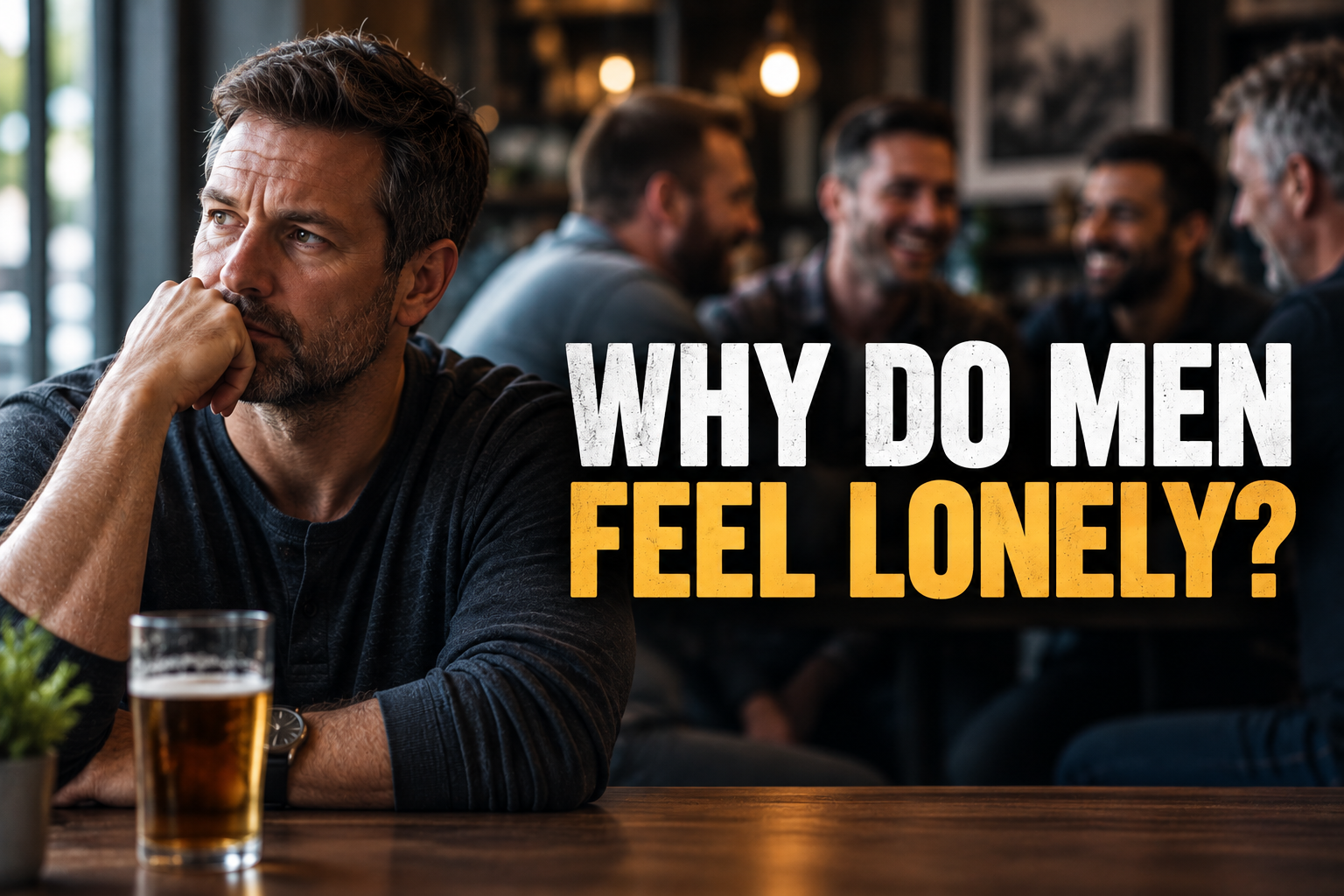
Why Do Men Feel Lonely Even Around Other People?
A man can be married, have children, work with people every day, know guys at the gym, and have hundreds of contacts in his phone and still feel lonely.
Loneliness is not simply being physically alone. A man can have an active social life and still lack the closeness, emotional support, intimacy, or sense of belonging he needs. This helps explain why men feel lonely even when they have friends, family, coworkers, and other people around them.
Recent U.S. research suggests that men are not necessarily lonelier than women or less likely to have close friends. The difference may be in how some of those relationships function. Men are less likely to turn to friends and several other people in their social networks for emotional support. (Pew Research Center)
What Is Male Loneliness?
Male loneliness is the experience of not having enough of the connection, belonging, intimacy, or support a man needs, regardless of how many people are physically around him.
It is important to distinguish loneliness from social isolation. Social isolation is more objective: a person has few relationships, limited contact, or little support. Loneliness is subjective: a person feels disconnected or dissatisfied with the closeness of his relationships. (CDC)
A man can experience either one without the other. Someone who lives alone and spends considerable time alone may have several deep friendships and rarely feel lonely. Another man might work in a crowded office, return home to his family, attend social events on weekends, and still feel disconnected because none of those relationships provide the closeness he needs.
This is one reason discussions about the so-called male loneliness epidemic can become misleading. Counting how many people a man knows tells us something about his social life, but it doesn’t tell us everything about the quality of his relationships.
Are Men Really Experiencing a Loneliness Epidemic?
The phrase “male loneliness epidemic” has become popular online, but the evidence is more complicated than the phrase suggests.
Pew Research Center surveyed 6,204 U.S. adults in 2024 and found that about 16% of Americans said they felt lonely or isolated all or most of the time. Importantly, there was no significant difference between men and women. Adults under 50 were substantially more likely to report frequent loneliness than adults 50 and older. (Pew Research Center)
That means it would be inaccurate to claim that men as a group are clearly lonelier than women. But that doesn’t mean there is no reason to pay attention to men’s loneliness. Researchers have found important differences in how men use their relationships.
Pew found that men and women were about equally likely to have at least one close friend, but men with close friends communicated with them less frequently through several forms of communication. More importantly, when asked whom they would be very or extremely likely to turn to for emotional support, 38% of men named a friend compared with 54% of women. (Pew Research Center)
That suggests a more useful question than Are men lonelier? Are men’s relationships providing the kind of support and connection they need when life becomes difficult?
The Three Levels of Male Connection
One way I think about this in my work with men is through three different levels of connection: Contact → Companionship → Connection. They overlap, but they aren’t the same thing.
Level 1: Contact
Contact means people are present in your life. You have coworkers. You know your neighbors. You talk to people at the gym. You interact with parents at your children’s school. You have people following you on social media and numbers saved in your phone.
Contact prevents complete isolation, but contact alone doesn’t necessarily satisfy our deeper emotional needs. You can interact with dozens of people every day without feeling close to any of them.
Level 2: Companionship
Companionship goes further. These are people you actually do things with. You might train Brazilian Jiu-Jitsu together, play golf, watch football, ride motorcycles, hike, game, fish, travel, or meet for drinks.
These relationships matter. Shared experiences are one of the ways many male friendships develop, and there is nothing inferior about friendships built around activities. But companionship can still exist without much intimacy. Two men can spend three hours together every Saturday for years and know surprisingly little about what is happening beneath the surface of each other’s lives.
Level 3: Connection
Connection develops when a relationship includes enough trust and depth that you feel known. These are the people you can call when something goes wrong. They know when your marriage is struggling, when you’re worried about money, when your father is sick, when you’re questioning your career, or when you’re simply not doing as well as everyone assumes.
The CDC describes social connection in terms of the size and diversity of our networks, the functions those relationships serve, and their positive or negative qualities. (CDC)
That provides a useful explanation for why many men feel lonely despite having active lives. A man can have plenty of contact, considerable companionship, and very little connection.
Why Can Men Have Close Friends and Still Feel Lonely?
Friendship is not an on/off switch. You can genuinely consider someone a close friend without discussing every part of your life with him. In fact, one of the most interesting findings in recent research is that the difference between men’s and women’s friendships may be less about whether friendships exist and more about how those relationships are used.
Pew’s 2025 report found that about 81% of U.S. adults had at least one close friend outside their family. Men and women were about equally likely to say they had one. But women were more likely to communicate frequently with close friends through texting, social media, phone calls, and video chats, while men were slightly more likely to see friends frequently in person. (Pew Research Center)
The emotional-support gap was larger. When people were asked whom they would turn to for emotional support, men were less likely than women to say a friend, their mother, another family member, or a mental health professional. Men and women were about equally likely to turn to a spouse or partner. (Pew Research Center)
This doesn’t mean men don’t know how to be friends. It means a man can have genuine friendships without those friendships functioning as places where he discusses the most difficult parts of his life. He can be socially connected and emotionally guarded at the same time.
Men Often Build Friendships Side by Side
Men frequently become friends while doing something together: work, sports, military service, martial arts, gaming, hunting, motorcycles, church, volunteering, or a shared hobby. That can be a strength because activity gives men a reason to repeatedly see one another, creates shared experiences, and removes the pressure of having to sit across a table and manufacture conversation. Some of the strongest friendships a man ever develops may begin this way.
The weakness becomes apparent when the activity disappears. You change jobs. You retire. You stop playing the sport. You move. You get injured. Your children leave the school where you knew the other fathers. The weekly activity ends, and eventually the friendship ends with it, even though nobody had a falling out.
If you want close friendships to survive different stages of life, eventually the relationship has to become bigger than the place where it began.
Why Vulnerability Can Be Difficult for Men
One explanation commonly offered for male loneliness is that men are taught not to express their emotions. There is truth in that, but it shouldn’t be reduced to a stereotype that men are emotionally incapable or that every man was explicitly told to suppress his feelings. Social expectations can be subtler than that.
A boy may learn that anger earns more acceptance than fear. He may discover that admitting insecurity gets him mocked while confidence gets rewarded. He may watch the men around him handle problems privately and learn that asking for help can be seen as weakness. Over time, protecting yourself can become automatic.
That strategy can also create a paradox. A man wants closer relationships while avoiding the behaviors required to create them. He wants to be known but rarely reveals anything important. He wants his friends to check on him but doesn’t check on them. He wants deeper friendship but waits for somebody else to make the first move.
Vulnerability Is Not Telling Everyone Everything
Vulnerability doesn’t mean turning every conversation into an emotional disclosure. Healthy relationships require judgment.
It might mean telling a friend, “I’m having a rough time with this,” instead of automatically saying everything is fine. It might mean admitting you’re worried about losing your job, asking another man for advice about your marriage, telling a friend you miss spending time together, or acknowledging that you’ve been feeling isolated.
Emotional intelligence isn’t expressing everything you feel to everyone around you. It includes recognizing what you’re experiencing and knowing when, how, and with whom it is appropriate to share it. You don’t need every person in your life to know everything about you, but most of us need at least a few people around whom we don’t constantly have to perform.
Men’s Friendship Networks Have Changed Since 1990
There is another part of this story that shouldn’t be ignored: American friendship itself has changed.
Research from the Survey Center on American Life found a substantial decline in men’s friendship networks between 1990 and 2021. In 1990, 55% of men reported having at least six close friends. By 2021, that figure had fallen to 27%. During the same period, the percentage reporting no close friendships increased from 3% to 15%. (The Survey Center on American Life)
This decline has sometimes been described as a “friendship recession.” (The Survey Center on American Life)
However, those numbers need context. More recent Pew research doesn’t show a large contemporary gender gap in whether adults have close friends. So the evidence shouldn’t be used to argue that today’s men are uniquely friendless compared with women. (Pew Research Center)
A more defensible conclusion is that American friendship networks have undergone significant changes, while men also appear less likely to use some of their relationships for emotional support. Those two issues can reinforce each other because a smaller network becomes more consequential when the relationships remaining in it aren’t providing much support.
Marriage Can Hide a Weak Social Network
A romantic partner can become a man’s closest friend, primary confidante, travel companion, social organizer, and main source of emotional support. There is nothing wrong with being close to your partner. The problem appears when she becomes nearly your only meaningful relationship.
Pew found that roughly three-quarters of American adults would be very or extremely likely to turn to their spouse or partner for emotional support, with no significant gender difference. But men were less likely than women to say they would turn to friends or other family members. (Pew Research Center)
That can create a fragile social structure. If the marriage becomes strained, ends in divorce, or a spouse dies, a man may discover that he didn’t maintain enough independent relationships around it. The loss isn’t only romantic; his entire support system may suddenly become smaller.
This is particularly relevant for single men and divorced or widowed men rebuilding a social life later in adulthood. The objective isn’t to replace romantic intimacy with friendship. The two relationships serve different purposes. It is to avoid expecting one person to meet every social and emotional need you have.
Fatherhood and Career Can Quietly Push Friendship Aside
One reason many men lose friendships isn’t dramatic at all. Life gets busy. A man gets married. Children arrive. His career becomes more demanding. Weekends fill with home maintenance, children’s activities, family obligations, errands, and the hundred small tasks involved in adult life. Friendship gets whatever time remains, and eventually very little remains.
Nobody consciously decides, I no longer need friends. The friendships simply stop receiving attention. This can happen gradually enough that a man doesn’t recognize what he has lost until something difficult happens and he realizes he doesn’t know whom to call.
Healthy relationships require maintenance. The friendships that felt effortless at 22 may require deliberate effort at 42 because proximity no longer does the work for you.
Young Men and Boys May Learn These Patterns Early
The differences in emotional support don’t suddenly appear in middle age. Pew’s 2025 research on teenagers found that 85% of boys said they had a close friend they could turn to for emotional support, compared with 95% of girls. Sixteen percent of boys said they didn’t have such a friend. (Pew Research Center)
That doesn’t mean boys and men are destined for isolation, nor does it establish that boys are universally lonelier than girls. It does suggest that differences in how friendships function can appear early.
If boys learn that friendship primarily means shared activity, humor, competition, and loyalty but receive less practice discussing emotional needs, those habits can follow them into adulthood. The solution isn’t teaching boys to socialize exactly like girls. It is helping young men learn that strength and friendship can include asking for help, checking on a friend, listening when something is wrong, and having conversations that go beyond the activity bringing them together.
Older Men Can Face a Different Kind of Social Isolation
The challenge can change again later in life. Retirement can remove daily contact with coworkers. Health problems can limit mobility. Friends may move or die. Adult children may live far away. Divorce or widowhood can remove a man’s primary source of companionship.
The CDC identifies older adults as one group at increased risk for social isolation, although loneliness itself can affect people across the lifespan. (CDC)
This distinction matters because older men may not necessarily describe themselves as lonely even when their social networks have become objectively small. If work provided most of your daily contact for thirty years, retirement planning shouldn’t be only financial. It should include another question: Who will still be part of my life when the workplace isn’t?
Technology and Social Media Can Create Contact Without Intimacy
We have more ways to communicate than at any previous point in history, but that doesn’t automatically mean we have more meaningful connections. You can follow a friend’s life on Instagram, send him a meme, respond to a group chat, watch his vacation through Stories, like a photo of his children, and go months without having a meaningful conversation with him.
Technology and social media aren’t inherently harmful to friendship. They can help people maintain relationships across distance and make regular contact much easier. The problem is confusing awareness with intimacy. Knowing what somebody is doing isn’t the same as knowing how he is doing.
Even Reddit, online communities, gaming groups, and other digital spaces can provide legitimate social connection for some people. But digital interaction varies enormously in quality. A thousand anonymous interactions aren’t necessarily a substitute for having someone who knows you personally and would notice if something were wrong.
The better question isn’t, How many people did I interact with today? It’s: Did I experience any genuine human connection today?
Why Some Men Lose Friends Without Ever Ending the Friendship
A surprising number of friendships don’t end because anything went wrong. A man changes jobs and stops seeing the guys he used to see every day. One friend gets married. Another moves. Someone has children. Weekend schedules stop lining up. Nobody says, “We’re not friends anymore,” but nobody calls either.
Six months becomes a year. A year becomes five. This is how male friends who once knew almost everything about each other can become people who occasionally like each other’s posts online.
Maintaining friendships in adulthood often requires deliberate action because the structures that created them, including school, military service, work, and sports, no longer keep everyone together automatically. Sometimes the solution to loneliness isn’t finding somebody new. It’s calling somebody you already miss.
Conflict Can Turn Distance Into Permanent Isolation
There is another reason men’s networks shrink that receives less attention: unresolved conflict. Two men can be friends for fifteen years, have one serious disagreement, and never speak again. Someone feels disrespected. Something gets said. One man believes the other should apologize first. Then pride takes over, neither calls, and a year later both men have lost a relationship that might have been repairable.
Resilience in friendship doesn’t mean tolerating abuse, betrayal, or repeated disrespect. Some relationships should end. But healthy relationships also require the ability to disagree, apologize, listen, forgive when appropriate, and repair damage.
Before deciding you need to make friends, it may be worth looking backward. There may already be someone in your life worth reconnecting with.
How Does Loneliness Affect Men’s Mental and Physical Health?
Loneliness deserves attention for more than emotional reasons. The CDC reports that loneliness and social isolation are associated with increased risk of depression and anxiety, heart disease, stroke, type 2 diabetes, dementia, self-harm, and earlier death. These are population-level associations and shouldn’t be interpreted as meaning that loneliness inevitably causes any particular condition in an individual. (CDC)
Social connection is also associated with positive health outcomes. Supportive relationships can help people manage stress and provide emotional and practical help during difficult periods. (CDC)
That doesn’t mean every lonely man has a mental health disorder, and loneliness shouldn’t automatically be medicalized. Sometimes loneliness is doing exactly what an uncomfortable emotion is supposed to do: alerting you that something important is missing. The question is what you do with that information.
What Should a Man Do If He Feels Lonely?
If you’re lonely, the first response shouldn’t automatically be “I need more friends.” Determine what is actually missing. Do you lack people entirely? Do you have acquaintances but few close friends? Do you have good friends but rarely talk to them? Do you have people to do things with but nobody you trust with difficult conversations? Did your social life disappear after divorce? Have work and family consumed the time you once spent with friends? Are there old relationships you allowed to fade?
Different problems require different solutions.
1. Strengthen One Friendship Before Trying to Build Ten
Think about the men already in your life. Who do you genuinely like? Who has earned your trust? Who would probably be receptive if you made more effort?
Call instead of only texting. Invite him to do something. Ask a better question than “What’s up?” And when he asks how you’re doing, occasionally give him a real answer. Close friendships are usually built through repeated small moments, not one dramatic conversation.
2. Reconnect With Someone You Lost
Think of one friend you genuinely cared about but stopped seeing because life became busy. It doesn’t require a five-paragraph explanation for why you haven’t spoken since 2019. You can simply say:
“I was thinking about you the other day. It’s been way too long. How have you been?”
Some relationships won’t restart. Others may have been waiting for one person to make the first move.
3. Put Yourself Somewhere Friendship Can Actually Develop
If you genuinely lack people, find environments that create repeated interaction. Join a martial arts gym, recreational sports league, men’s group, volunteer organization, church community, hiking group, class, professional organization, or another activity you genuinely enjoy.
Pew’s 2025 survey found that 56% of U.S. adults believed all-male groups have a positive effect on men’s well-being. (Pew Research Center)
The important ingredient isn’t simply joining a group. It’s repetition. Friendship rarely develops because two people meet once. People become familiar, shared experiences accumulate, trust grows, and eventually the relationship can exist outside the activity that created it.
4. Let Someone Know You Better
If everyone around you believes you’re doing great while you’re privately struggling, adding more people to your calendar may not fix the problem. Choose someone trustworthy and reveal a little more. You don’t need a dramatic emotional confession. You might simply say:
“I’ve actually been having a harder time lately than I’ve been letting on.”
Intimacy grows when people gradually allow themselves to be known.
5. Become the Friend You Wish You Had
If you want friends who check on you, start checking on people. If you want people to invite you somewhere, organize something. If you want more honest conversations, ask better questions. If you want friends who remember what’s happening in your life, remember what’s happening in theirs.
Don’t wait for everyone else to create the social connections you want. Friendship is reciprocal.
Frequently Asked Questions About Male Loneliness
Why do men feel lonely even when they have friends?
Men can feel lonely when their relationships provide companionship without enough closeness, belonging, intimacy, or emotional support. Having friends and feeling deeply connected aren’t identical. Recent Pew research found that men and women were similarly likely to have close friends, but men were considerably less likely to say they would turn to a friend for emotional support. (Pew Research Center)
Are men lonelier than women?
Current U.S. evidence doesn’t show a significant overall gender difference in frequent loneliness. Pew found roughly equal shares of men and women reporting that they often feel lonely or isolated. The more notable gender differences involve how people communicate with friends and whom they would turn to for emotional support. (Pew Research Center)
Why are men’s friendships different?
There is no single type of male friendship, but many men build relationships through shared activities and experiences. Survey data also show that men are less likely than women to turn to friends for emotional support and communicate with close friends less frequently through several channels. These patterns don’t make men’s friendships inferior, but they can influence the kind of support available when life becomes difficult. (Pew Research Center)
Can you be lonely while married?
Yes. Loneliness reflects the connection someone experiences, not simply relationship status. A person can have a spouse, family, coworkers, and friends while still feeling disconnected. A romantic partner can provide important intimacy and support without being able to meet every social and emotional need.
Why do some men become more socially isolated as they get older?
Work changes, retirement, divorce, widowhood, health limitations, relocation, and the gradual loss of activity-based friendships can reduce a man’s social network. The CDC identifies older adults as one population at greater risk for social isolation. (CDC)
How can a lonely man make friends as an adult?
Start with repeated environments where interaction happens naturally: sports, martial arts, volunteering, faith communities, classes, hobbies, professional groups, or community organizations. At the same time, look at existing relationships. Reconnecting with an old friend or deepening an acquaintance may be easier than building every friendship from scratch.
What is the difference between loneliness and social isolation?
Loneliness is subjective: you feel disconnected or lack the closeness and belonging you want. Social isolation is more objective: you have few relationships, limited contact, or little support. A person can experience either condition without experiencing the other. (CDC)
The Goal Isn’t to Know More People. It’s to Be More Connected.
If you’re surrounded by people but still feel lonely, don’t immediately assume you need a larger social circle. Look more closely at the one you already have.
You may have plenty of contact but little companionship. You may have companionship but very little genuine connection. Maybe you have friends but never allow them to see when you’re struggling. Maybe your spouse has gradually become your entire support system. Maybe fatherhood and work pushed friendship to the bottom of your priorities. Maybe there are men you once considered brothers who disappeared from your life without either of you consciously deciding to end the friendship.
Loneliness can be useful information. It tells you there is a gap between the relationships you have and the relationships you need. Closing that gap takes effort. You have to show up, initiate, maintain relationships, ask better questions, allow trustworthy people to know you, repair friendships worth saving, and put yourself in places where new relationships can develop.
You don’t have to choose between independence and human connection. You can be capable and still need friends. You can be resilient and still need support. You can solve many of your own problems and still benefit from having men around you who know who you are when things aren’t going well.
That’s friendship.
Get your FREE copy of Brotherhood Bonds: A Man’s Guide to Making Friends Last a Lifetime. If you’ve realized that your own friendships aren’t as strong as you’d like them to be, Brotherhood Bonds was written for exactly that problem. It explores how men make friends, why those friendships disappear, how to reconnect, and what it takes to build the kind of brotherhood that survives work, marriage, distance, conflict, and the different stages of a man’s life.